Showing posts with label Japan. Show all posts

Saturday, August 10, 2024

5/22/24: Hiroshima-Shanghai, China: Culture Shock!


After an exciting and fascinating three-week trip through a good chunk of Japan, Steven and I were ready for a new adventure. We'd previously visited China on our first overseas trip together way back in 2013 when we hopped on the Trans-Siberian train that took us through Russia and Mongolia (with several stops along the way!) before reaching Beijing. The capital and a later stop in Xian to see their famous Terracotta Warriors whetted our appetites to return and explore more of the huge nation. Though Steven had previously visited Shanghai and Hong Kong, he was agreeable to including both cities on our return trip as long as we also included a stopover in Tibet to see Potala Palace which had long been on his bucket list. More on the latter places in upcoming posts including our visit to Chengdu but let's start with Shanghai.

I was excited that our flight from Hiroshima landed at Shanghai's Pudong International Airport instead of the Hongqiao one as it meant we could take the Maglev train into the city. Suspended above the track and propelled by magnetism, it left every twenty minutes so we didn't have to wait and took just eight minutes to get into the city. 


Amazingly, the Maglev accelerated to 300km/hr in the first four minutes before immediately decelerating. If we'd been on the train an hour earlier, the maximum speed would have been 410km/hr but it only reaches that higher speed for two hours a day. Don't ask me why, but if you find out, make sure to let me know, too!


I kept one eye glued to the display board noting the time and speed every few seconds and the other on what we could see as we whizzed by! 


In case you're wondering, no, we didn't 'feel' the excessive speed at all as the ride felt extremely smooth and not rocky as I'd expected. 


I couldn't remember ever seeing so many highrise buildings in such a concentrated area before. If I'd been able to count them as we sped by, I wouldn't be surprised if there were a couple of hundred of them. 


If you read my last post, I remarked on the few motorcycles we saw in Japan and also how each car was in pristine condition. However, our first sight of the motorcycles and cars at the airport showed we were no longer in Japan as we spotted many cars that were banged up. I'd read that taxis were not only ubiquitous but also very cheap and that was certainly the case with the one we hired. As the train only stopped at one metro station, it was still an hour-long ride to our hotel in the center of the city. Even so, the cost was under $10. 


Driving in Shanghai wasn't for the faint of heart because of the intense traffic and maze of highways!


On the long taxi ride, we had plenty of time to appreciate the lovely flowers that adorned the planters in the medians!


Just a few blocks from our hotel was the pedestrianized Nanjing Road, not just the biggest shopping street in Shanghai but also one of the world`s busiest shopping streets. We spent a couple of hours that first night window shopping at shops known the world over like Gucci, Cartier, Louis Vuitton, Prada, Tiffany & Co., Fendi, Bvlgari, Hermes, Salvatore Ferragamo, as well as enticing Chinese stores. 


Too bad our grandchildren are so young as otherwise they probably would have been able to tell me who these huge cartoon characters were!


Shanghai is known for its great architecture and several of the buildings we passed on Nanjing Road lived up to its reputation. I couldn't wait to explore the city further to see what else awaited us.


Unlike in Japan, we immediately felt a strong police presence in Shanghai with police officers walking up and down the street, on bikes, and in small towers like this one. It was rather unnerving after coming from Japan where police were rarely visible.


The sculpture honored shopping as a family!


A pervasive sight on the massive number of motorcycles in Shanghai were these jackets that presumably helped riders when facing the wind. We were in China for a couple of weeks but I don't remember seeing others any place other than in Shanghai. Was it because of the unique weather conditions there, great marketing, or something else altogether different, I wondered. 


Next post: Exploring Shanghai's Old City including the beautiful Bund at night.

Posted on August 10th, 2024 from our home in Denver's suburb of Littleton. Please make sure to take care of yourself and your loved ones while enjoying summertime weather.

Wednesday, August 7, 2024

Impressions from Our Japan Trip

If you read some of the preceding posts I wrote about our tour of Japan, I hope you got the sense of what a great trip it was from beginning to end. Japan was a country I had longed to visit for years as Steven had already been lucky enough to tour many moons ago. The temples, the shrines, many of the museums, the traditional crafts, and the small cities, in particular, were an absolute delight. It was fascinating to learn about the Japanese way of life and to be exposed to what in some circumstances were quirks to us, as we explored the country almost from one end to another. After spending three weeks in Japan many things struck Steven and me - some fantastic, some off-putting, and others that were simply unusual to us. You can decide from the list below what category each observation may fall into!

1. It might seem unbelievable but we saw no litter in the streets and very few trash cans. We did notice signs not to leave trash in bathroom garbage cans, and not empty Coke cans in sinks. 

2. There was NO graffiti anywhere, period, that we observed.

3. The roads were superbly maintained with nary a pothole or bump. There was excellent signage on roads and highways.

4. In the same vein, however, we found the omnipresent signage in museums, metro stations, parks, etc to be off-putting as it directed us to walk left, go down the stairs on the left, to not stand in front of the trains at the metro, etc.

5. Unlike so many countries we've traveled to, the sidewalks were even so we didn't have to worry about taking our eyes off them and tripping up.

6. On the flip side, however, it was tough walking on sidewalks because bicycles and scooters wove in and around pedestrians, strollers, and wheelchairs. 

7. No one seemed to think of jaywalking or even contemplate crossing the street if the light was red even if no vehicles were visible and it meant waiting a couple of minutes for the light to change to green. It took our utmost patience to follow those "rules!"


8. Japan would be an ideal country for travelers with special needs with curb cuts at every intersection, and elevator buttons at wheelchair height as well as "normal" height. 

9. Sadly, however, Priority Seating signs on public transportation were almost universally ignored by people of all ages.

10. Special needs or not, it was incredibly easy to travel around Japan as long as you were conversant in English as all transportation signs were also in English. As I've written several times, however, rarely was information available in English at temples, shrines, and museums.

11. Most people in service industries had enough knowledge of English to communicate with tourists. 

12. Public transportation was very inexpensive which made it extremely easy to get around anywhere. The ticket machines were easy to navigate once we understood the price was normally dependent on the distance traveled. You could count on buses and subway cars leaving every ten minutes or so, so there was never a long wait to get where we wanted to go. We just had to remember to hold onto our metro tickets to insert them into a machine before being able to leave the station.

13. We felt like we might have been in the Netherlands as bicycles reigned supreme in Japan. Mopeds and motorcycles were few and far between by comparison. 

14. Back-in parking was the norm (the law?) although we detected no signs indicating that was required unless they were in Japanese of course! It was common to see parking attendants walking around the parking lots gesturing where drivers should park. They also appeared to record license plates and the time when drivers entered on a clipboard.

15. Steven and I had never been anywhere where we'd seen so many brand-spanking clean cars seemingly in such pristine condition. NONE we saw were clunkers!

16. It took us a tad too long to get used to the shape of stop signs in Japan as they were in the shape of Yield signs in the US. Google Map directions kept advising us to stop ahead but we only saw what we thought were yield signs until I realized Google Maps really did mean for us to stop - oops!


17. There were free public toilets everywhere unlike in US cities and towns where their absence causes huge problems for residents and travelers alike. As you might imagine, each restroom, regardless of whether it was private or public, was sparking clean. 

18. I sure could get used to the heated toilet seats, and the front and back sprays at the push of a button. The sounds of a waterfall in the toilet stall to mute other sounds was a bit much, however!

19. I wasn't a big fan of the wafer-thin toilet paper either.

20. All over Japan, there was a plethora of McDonald's, a few Denny's, KFCs, and Burger Kings but no Subway restaurants.

21. Japanese women, in particular, were impeccably dressed with nary a hair out of place and looking like they had just stepped off a Paris runway. 

Their dress style was noticeably different than what we see in the States with long flowing dresses, often multi-tiered, with lots of gauze and chiffon being the norm. Children were also dressed like little fashion plates. 

22. Businessmen seemed to have a dress code, almost uniformly wearing black suits, white dress shirts, and brown pointy shoes. I found the sea of uniformity difficult.

23. I bet you I could almost count the number of men with facial hair on two hands. Shaving cream must be a top seller!

24. The professional appearance of both taxi and bus drivers was very noticeable as all except one we encountered wore black suits, dress shirts, and white gloves. 

25. Apart from a couple of murals in Osaka, there were no murals or street art anywhere. It was sad seeing no free expression of art. 

26. There was consistently fast internet throughout the country which made keeping in touch with family and friends and updating the blog a breeze.

27. I generally found Japan to be a nation of "no" with rules posted absolutely everywhere: No talking on phones in public, no smoking on streets, no eating while walking, no bike parking, and even no holding hands in a restaurant in Hiroshima.


28. We observed people kept to themselves while walking with little interaction, and no engagement or eye contact. Conversely, people were very friendly when asked a question, etc.

29. Ice cream fans are in hog heaven in Japan as ice cream cones are available for a couple of bucks every hop, skip, and jump. I sure didn't object to that!


30. The artistry with the presentation of food in stores was a delight to feast our eyes on every time.

31. There seemed to be an extremely limited selection of fresh fruit and vegetables in the grocery stores and in the food halls of department stores. 

32. We saw an inordinate number of bakeries and boulangeries all over the country which surprised me and also delighted us both.

33. Japanese must have a HUGE fascination with cookies as, despite their stick-thin figures, never have I seen so many boxes and boxes of small cookies delightfully arranged and wrapped. 

34. Almost on every block, there was a 7-11, a Lawson's, or a Family Mart convenience store selling prepackaged food, drugstore items, drinks, etc.

35. Unlike the US and my native Canada, there was no tipping.

36. Trust in the goodness of human nature was apparent in many stores, even very large ones, with cashiers regularly located at the back of stores. It's sad but I can't see such trust or the honor system being rewarded in the US or Canada.

37. The ratio of workers to shoppers in the food halls of department stores was striking - we've certainly never seen anything like that anyplace else. 

38. Very few police officers were present in the streets or observed in shops - again a striking contrast to other countries we're familiar with. 

39. Being a huge fan of hot tea, I was delighted there was a kettle in every hotel room or Airbnb we rented. Before we downsized our bags, we always brought a mini electric kettle with us so having one at our ready disposal was a relief. 

40. Paper napkins seemed to be unheard of in Japan - instead packaged wet wipes were handed out every time. What a sad story for the environment in my opinion. 

41. Flowers and gardens, both public and private were immaculately maintained.
 

Next post: Culture shock as we headed to Shanghai, China!

Posted on August 7th, 2024, from our home in the suburbs west of Denver. Fortunately, the Quarry Fire is no longer a threat to homeowners just a few miles from us. Please take care of yourself and your loved ones. 

Sunday, August 4, 2024

5/21/24: Magical Miyajima Island nr. Hiroshima


After visiting the sobering sights in Hiroshima the day before, a day trip to the nearby scenic island of Miyajima in the Seto Inland Seto was a delightful change and exactly what Steven and I needed on our last day in Japan. Almost from our hotel doorstep, we hopped on the streetcar for the hour-long ride through the city to the last stop and then a three-minute walk to the short ferry ride bound for Miyajima. You may have seen photos of the island's most famous landmark, a huge, vermilion-colored torii or shrine gate emerging from the water. 


While the island is more commonly referred to as Miyajima, it's officially named Itsukushima, Japanese for "shrine island" because the island is so closely related to its key shrine, Itsukushima Shrine. If you look closely, you'll notice why the island has been called the Goddess of the Mountain from its profile with the trees at the top of the mountain resembling eyelashes. 


I overheard a guide on the ferry say that because the island had been considered sacred, no one could touch it at one time. Neither giving birth nor dying was allowed on Miyajima so both pregnant women and the ill were quickly ferried across to the mainland. Local superstition allowed for neither a hospital nor a cemetery. Unlike most places in Japan, the trees were never cut down. 

Now one thousand people live on the island and it's visited by five million tourists annually. As had become the norm in Venice and Amsterdam, a tourist tax was likewise imposed on all visitors to Miyajima last year to preserve the old houses. Building rules were very strict on the island so that views of the torii wouldn't be obstructed and the traditional style of homes was mandated. 


The Japanese people have ranked Miyajima as having one of the three best scenic views in the country. The other two are Matsushima in Tohuku and Amanohashidate, a remote sand spit on the coast of the Japan Sea. The view of Miyajima's giant torii gate seemingly floating on the water just offshore at high tide was what merited its high ranking. Though high tide had been at 8 that morning, the guide said it would still be high enough for us to view the submerged torii gate when we arrived close to 11.


One of the largest torii in Japan, the gate marked the border between the sacred and the secular. It was built in 1875 of camphor wood which was naturally resistant to rot and insects. The vermilion lacquer also protected the wood from further damage. The gate measured more than 16 meters tall. The current six-pillar style dates to 1547 and weighed 60 tons including 4 tons of stones placed in the upper lintel. I was surprised that the structure was held upright only by its own weight and not embedded in the seabed. The bright red gate has only been replaced seven times over the centuries with the most recent time just last year. It replaced the gate from 1875 - we were lucky we hadn't missed the glorious sight.  


As we'd seen in Nara, wild deer were prevalent on the island and had also become accustomed to people. It was cute seeing them wander around the same sites as the tourists. But, unlike in Nara, the deer on Miyajima couldn't be fed.


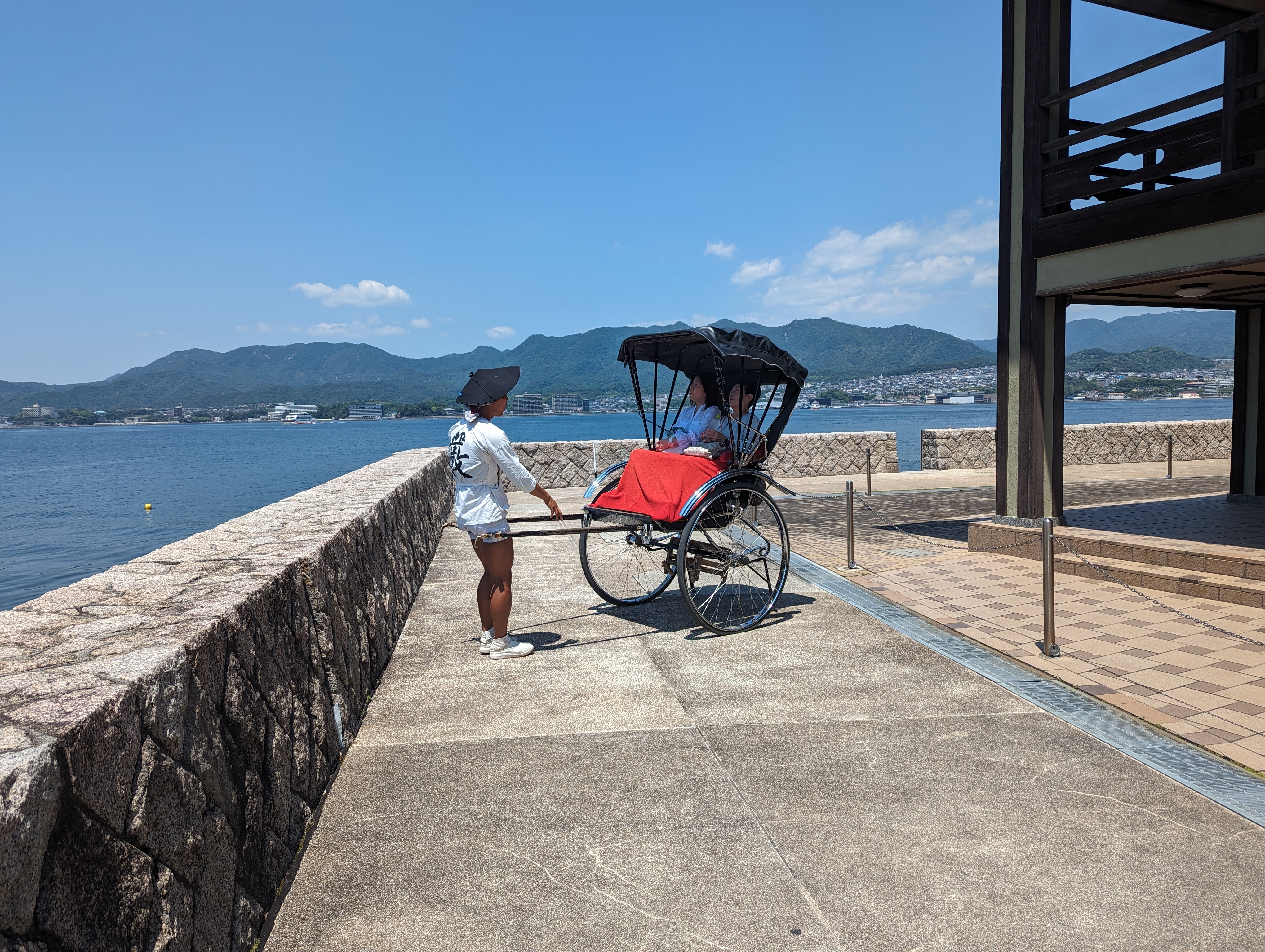
A walk along the seawall was the more peaceful option to view the torii up close compared to making our way through a street full of souvenir stores.  


A short walk from the pier was the island's major attraction, the wooden Itsukushima Shrine which was founded in 593 to honor three female deities. As it was built over water, it looked as though the shrine was floating on water when the tide was in. Though most of the shrine's buildings date from the 16th century, they have been repaired repeatedly since.

The Marodo Shrine was for guest deities.


In the distance was the closed, 27-meter-tall Five-Storied Pagoda.


Takabutai was an elevated stage where ancient court dances called bugaku were performed.


The tide had receded so much that all we saw was mud under the steeply arched pedestrian Soribashi or Moon Bridge. 


We didn't know what building this was but it certainly attracted lots of attention from the shrine's visitors. 


Candles were marked for safety and well-being, good luck and to ward off level, for the souls of ancestors, for the souls of unborn babies, etc. It was the first time we'd seen candles marked for special wishes at any temples, before. 


The Itsukushima Shrine Treasure Hall, built in 1934, displayed artwork, handicrafts, swords, costumes, masks, and other valuable items acquired by the shrine. Most had been donated by prominent or influential donors to display their faith or express their thanks to a deity. The shrine was popular from the 9th to 12th centuries when the list of donors included emperors, high-ranking aristocrats, and powerful warlords. Some of the gifts have been designated as National Treasures. 


The omigoromo was a costume worn until the latter half of the 19th century by priests when dedicating bugaku dances to the shrine.


The Edo Period painting depicted 12th-century Tokiwa Gozen, the mother of a great samurai hero. It was presented to the shrine as an ema devotional offering even though ema normally referred to the wooden votive tablets on which wishes and prayers were written and offered at Shinto shrines. Traditionally, however, ema were images of horses that Shinto deities were thought to ride. In ancient Japan, living horses were often presented to shrines and were associated with prayers related to rain. While wealthy devotees often presented large and elaborate works of art such as ema, less affluent people donated much smaller, simpler images which later developed into the wooden ema tablets we'd seen at shrines throughout Japan.


It was rare that a complete set of weights for scales from the Edo period were preserved. 


Another sight on the island was the Daisho-in Temple, one of the most famous temples in western Japan belonging to the Shingon sect of Buddhism. Located at the base of Mount Misen, it was where the sect's founder, Kobo Daishi, first began the practice of Buddhism on Miyajima.


Two fierce-looking deities stood guard at the shrine's entrance.


While walking up the long row of the temple's steps was a row of spinning metal wheels inscribed with sutras or Buddhist scriptures. Turning the inscriptions is believed to have the same effect as reading them. 


Halfway up the stairs were oodles of red-capped tiny Buddhist statues.


A little further on was a small temple with the 10th-Century Seated Fudo Myo'o.


Nade-Botoke was nicknamed the Touch and Care Buddha because if you had a pain in your body, you just needed to touch the same part of the statue to be cured soon. Would that life worked so easily!


It was unusual seeing evidence of Tibetan Buddhism in Japan.


In the Main Hall was a lovely sand mandala made by visiting monks from Tibet. 


A small sign indicated this was an Omikuji, a fortune telling sacred idol. 


Statues lined the entrance to another of the temple's buildings ...


and inside were countless more.


An inori crane sculpture: 


From the highest temple building we had a panoramic view of the Seto Inland Sea and Hiroshima.


A secondat stairway leading down had hundreds and hundreds of stone statues of monks lined up on both sides. They were called Rakan.


I didn't examine the statues closely but each appeared to be unique. 


As a huge knitter, I wonder who had knitted all the jaunty red caps and when and how often they had to be replaced as they were constantly exposed to the elements. 


Every now and then, a machine pumped out fog which created a mysterious atmosphere. 


We encountered some unusual flowers on our way back to the village of Itsukushima.


We enjoyed a late lunch with BBQ chicken on skewers.


A better view of the Five-Storied Pagoda we'd viewed earlier in the distance: 


The water by the torii had receded so much in the intervening two-and-a-half hours that it would have been easy for us to walk right out and touch the shrine gate.


Running the gamut of souvenir shops back to the port:


We'd planned to take the boat back to central Hiroshima but unfortunately the tide was too low so we retraced oursteps from the morning, taking the ferry back to the mainland and the tram back from there to central Hiroshima. 


Bidding adieu to magical Miyajima and its sacred torii:


We spotted a white building across from Miyajima and found out on Google that it was the Mori Art Museum, a wood art museum owned by a religious cult. The building has three golden Buddhas on the roof and a large white rabbit in front of a tree.


Next post: A recap - impressions after three weeks traveling through much of Japan.

Posted on August 4th, 2024 from San Francisco where we came to meet our almost three-week-old grandson and spend time with his siblings and parents. It's tough having a child in every time zone in the US but at least we're lucky enough to be able to visit our five grandchildren in Chicago and here in San Francisco a few times a year. Wishing you and your loved ones peace and good health.