Showing posts with label Wisconsin. Show all posts

Monday, August 16, 2021

6/17/21: Milwaukee's Mitchell Domes

Before heading to Chicago in June from Milwaukee, Wisconsin, we stopped at what was known officially as the Mitchell Park Horticultural Conservatory, but better known as The Domes for obvious reasons! It was home to living plants from all over the world. The Conservatory was composed of three beehive-shaped glass domes, also referred to as the world's first conoidal domes, and were constructed in stages from 1959 to 1967.

Walking into the Tropical Dome was a little like entering a steamy rainforest and being transported to another world with some 1,200 species of plants taking up every inch of the Dome. 


The unusual Flamingo Flower was native to Colombia.


How little ones would love to see the Fairy Garden! One of the plants in the garden was an Earth Star - your guess is as good as mine as to which one it was!

I am almost always in the mood for chocolate and seeing this Chocolate Pudding Tree reminded me of that. The black sapole tree from southern Mexico and Central America bears a fruit that looks like a tomato and is high in Vitamin C. After the fruit ripens, the inside is dark brown, almost black, and is soft and sweet. When lemon or lime juice is added, the fruit can be used as pie filling.


These other plants and flowers caught our attention.

As a child growing up in Canada, I remember so well chewing Chiclets, the tiny square-shaped pieces of white gum. One of the original Domes plantings from 1966 was the Chicle Tree popular with Indigenous peoples from Mexico to Costa Rica. After making zigzag gashes into the tree, they collected the dripping gum and mixed it with flavorings to chew. The Wrigley Company helped develop a similar product to make chewing gum which was marketed as chiclets.


This Bromeliad was from Brazil.

We entered the Show Dome next where five times a year that was the place to be for themed floral displays of flowers. As we were there outside one of those windows, the dome was easily missable in my opinion.


Because of the pandemic, visitors were required to follow the woodchip path in one direction and also practice safe distancing.

The Show Dome was a little too rah rah for me promoting the city's parks, its lakes, etc. 

Cyril Colnik, 1871-1958, has been called "The Tiffany of Wrought Iron Masters" who achieved national fame as one of the foremost metal craftsmen of his time. Colnik was commissioned to build these stunning iron gates for the original Mitchell Conservatory that was opened from 1898 until 1955. 

This marvelous lion head and seven others watched over the park's Sunken Garden and Water Mirror from when it opened in 1904 until they were removed in 1966. There was no explanation given why the formal gardens and water mirror were demolished in 1994.

As we hadn't been very impressed with the Show Dome, we hoped the last dome, the Desert Dome, would shine. 

Even though Steven and I have spent a lot of time in the deserts of the American Southwest, I hadn't known until our visit that there was often more biomass lying underneath the surface than above it. Geophytes, like this Climbing Onion, are plants that appear when water is plentiful. When there is no water, the plants spend time underground bulbs, tubers, or corms. When they get wet, they start to grow again to produce seeds for the next generation.

Dennis and Gail: I wonder if you will see some of the impossibly tiny Silver Teaspoons when you get to Madagascar. Make sure to let me know, ok?!

We learned there were many different ecosystems on the southern tip of Africa. On the western coast was the Namib Desert whose main source of water was fog from the ocean. A bizarre-looking relative of conifers was the welwitschia which makes its home in the Namib. To survive, a giant taproot essentially 'drills' for water deep underground.

More plants from Madagascar:


Steve, a seven-year-old Bearded Dragon, moved to the Domes from a reptile rescue in 2017. His native habitats were the woodlands and deserts in Australia. Steve liked to sit under the heat lamp to raise his body temperature to 95 degrees or higher. 

The Fan Aloe was from South Africa. 

An unusual-to-us plant was the Desert Candle also from South Africa. I thought it was a cactus but learned it was in fact a Columnar Euphobia as virtually all cacti are only found in the Americas. The role of large succulents in African deserts is the same as cacti - to conserve water and protect the plant.


These cacti or euphorbia reached the highest parts of the dome.

One of the oddest natural wonders we'd ever seen were these Living Stones. Just by looking, it was easy to see where these plants got their name: their coloring and shape help them look just like stones. This adaptation has saved them from being found and eaten. The windows or 'clear skin' found in patterns across the top of their leaves was another survival mechanism of living stones. Beneath the windows was a thick layer of the plant's water storage tissue that hits the cells only after sunlight passes through this watery core.

These tiny living stones were grown at the Domes from seeds planted in 2013. It has taken that long for the stones to grow to the present size.

According to a sign at the Domes, the Middle Eastern Date Palm has been called a Tree Life, a Game Changer, a plant that has changed human history. Frustratingly, however, there was no further indication or explanation for those radical descriptions. 

One of my favorite memories from our time in Israel was visiting the home of people we had met a few weeks earlier in Bulgaria who later invited us to spend a day traveling with them and at their home. I can remember as if it were yesterday how moist and luscious the dates were that were picked off one of the date palms and which I popped into my mouth! Never since have I had a date that came anywhere close to those, including buying some from a date farm in Arizona this past January.

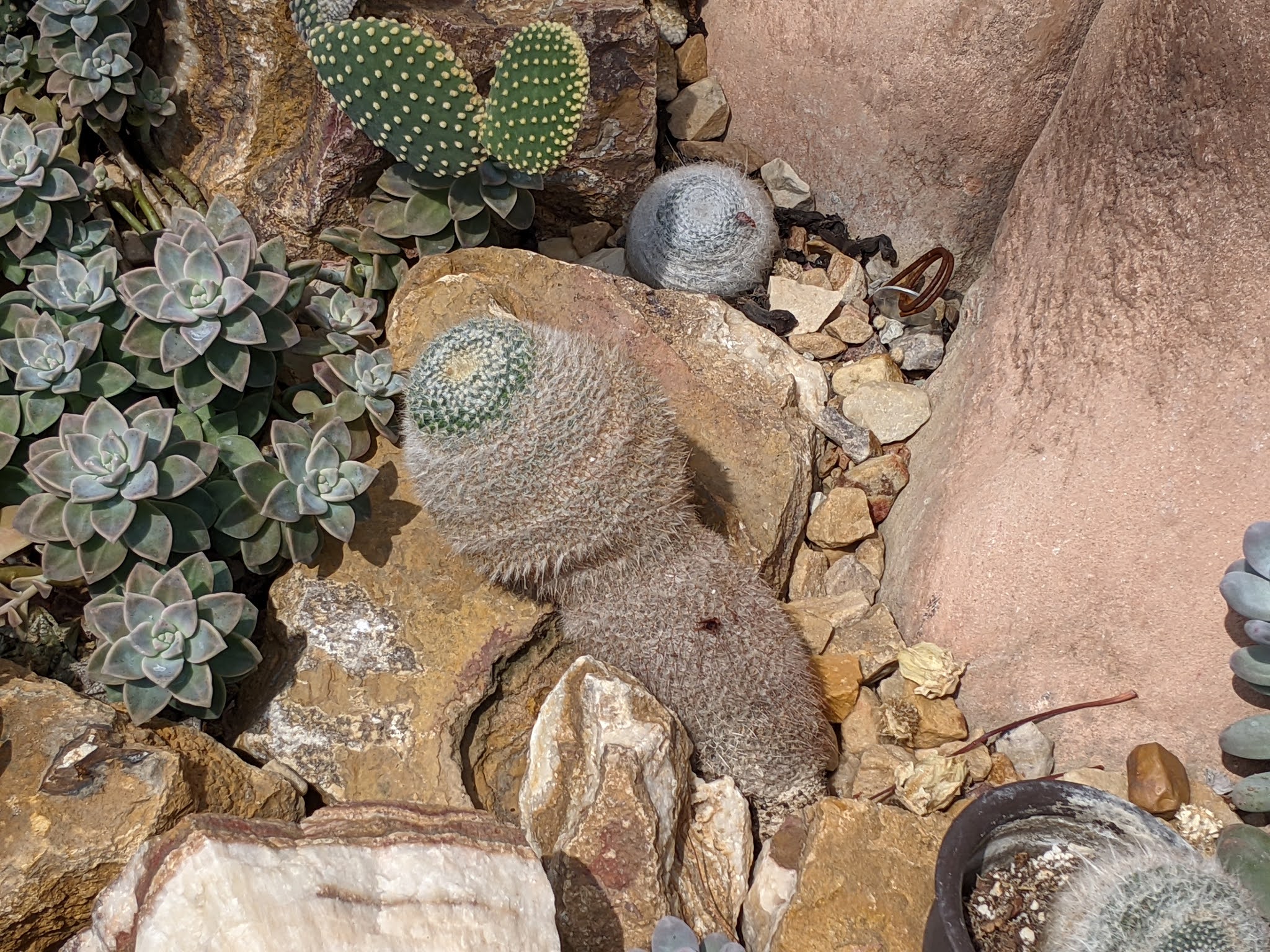
It was easy to see this Old Man Cactus got its name from the gray-white whiskers that covered the entire plant. Even though plants obtain their energy through sunlight, too much overheating causes cell damage. The old man's 'beard' shades it from intense sunlight and scorching temperatures from the plant's home in Mexico. A cacti-growing craze began in Europe after WW I after collectors saw the fuzzy appearance of this cactus.


I bet you figured I did really like the Desert Dome, right?!

Were Milwaukee's Mitchell Domes fabulous? I'd say no but they were definitely worth seeing and a feather in the cap for the city. 

Next post: Photos of Chicago's Wicker Park neighborhood where our daughter and her family live.

Posted on August 16th, 2021, from Tallahassee in eastern Florida as Steven and I were forced to evacuate yesterday afternoon from Grayton Beach State Park on Floria's Panhandle for at least three days because of Tropical Storm Fred. We won't know for another couple of days whether the park will reopen and we can return to our 'happy place' for a few more precious days. 

Tuesday, August 3, 2021

6/17/21: Milwaukee's MANY Charms!


Since we couldn't meet up with our daughter and her family in Chicago until late afternoon, Steven and I had most of the day to piddle around after we left Madison, Wisconsin where we'd spent the last couple of days. As the city of Milwaukee was only about 80 miles due east of Madison and about the same from Chicago, that seemed like a perfect place to explore. 

When immigrants from more than 30 European countries flocked to Milwaukee during the 19th century, they brought with them their skills, arts, and cuisines. Milwaukee especially saw the arrival of the Forty-Eighters, refugees from unsuccessful revolutionary movements against German monarchies in 1848. During the last half of the 19th century, Milwaukee was referred to as the German Athens because of that group's contributions to culture, politics, and music societies. In some neighborhoods, especially on the city's northwest side, English was almost never heard. By the late 1870s, there were six daily newspapers published in German!

Knowing of my fondness for Frank Lloyd Wright's architecture, Steven routed us to Annunciation Greek Orthodox Church in the Milwaukee suburb of Wauwatosa. Unlike Wright's Unitarian Meeting House in Madison the afternoon before, we were very fortunate that this church was open and a staff member pointed out several of Wright's highlights.


The church, one of Wright's last works, was designed in 1956 and completed in 1961 after his death. Like Madison's Meeting House, the church is listed on the National Register of Historic Places. After receiving the commission from the Milwaukee Hellenic Community, Wright consulted his wife about the church symbols as she had been brought up in the Greek Orthodox faith. As she stipulated the cross and dome should be preeminent, those became the dominant architectural features in the church. 


The church staff member talked about the curved stairway, the shape of the church pews, and light fixtures - all characteristic of Wright's style.


It was impossible to miss the amount of gold-anodized aluminum in the church. That was a new material in the late 1950s that Alcoa established. I don't think we'd have noticed, however, the unusually large eyes and ears in the faces in the Greek icons until we were told it was so the faithful could better see and hear the Bible verses.


Wright had designed simple glass windows for the church but the parishioners preferred stained-glass ones, so families 'adopted' the beautiful new ones. 


Wright explained in a letter dated September 9, 1958, when the project was well into the stages of the working drawing: "The edifice is in itself a complete work of modern art and science belonging to today but dedicated to ancient tradition—contributing to Tradition instead of living upon it." We admired that while Wright was inspired by Byzantine forms and Istanbul's Hagia Sophia in particular, the Milwaukee church superbly fit into its Midwest location.

Like so many church congregations, the Greek Orthodox Church had seen its membership drop from almost 800 families in the 1970s to 300 now. We were therefore happy to make a donation to the church's website. 


What has really made Milwaukee famous is beer. If you love American beer, you no doubt have heard of the Pabst brand. German-born Captain Frederick Pabst, 1836-1904, helped make Pabst Brewery the world's largest in the 1890s. Five Catholic Archbishops were fortunate to live in his elegant Flemish Renaissance Revival mansion between 1908 and 1975 when the property was purchased by Wisconsin Heritages, Inc.

Pabst was one busy man: he not only rebuilt the Pabst Theater in 1895, constructed the city's first skyscraper in 1891, operated the Whitefish Bay Resort, headed up the Wisconsin National Bank, owned a local hotel and many saloons, a hops farm and street railway in Wauwatosa, but also hotels and restaurants elsewhere in the country - phew!


Not too far away was Marquette University where I hopped out of the car to look at the statue named after the university's founder. Frenchman Louis Marquette was a 17th century Jesuit missionary and explorer who lived among various Indigenous Great Lakes people for nine years. With their help, he explored the western Great Lakes and, accompanied by Louis Joliet, the Mississippi River system. Marquette died at the age of 38 in Michigan in 1675.


Unfortunately, the small Joan of Arc Chapel was closed. I just read that the chapel which dated to 1420 in France's Rhone Valley, was dismantled stone by stone and brought to Long Island, NY, in the 1920s by a daughter of a shipping magnate. She wanted it to be next to her French  Renaissance chateau she had also purchased in France and had shipped over! Not surprisingly, the French shortly thereafter enacted a law banning the export of such treasures. After the chateau burned down, the chapel was donated to the university which welcomed it to the university public in 1966.


Showing his trademark double thumbs up in his cool leather jacket and jeans in downtown Milwaukee, the Bronze Fonz statue paid homage to Fonzie, the "tough guy, king of cool" from Happy Days, the popular sitcom set in 1950s Milwaukee. The statue was 5'6" just like Henry Winkler, the actor who portrayed the Fonz on TV. Too bad Steven had had to double park or we'd have enjoyed a stroll along the River Walk. 


The aforementioned ornate Pabst Theater, built in the 1890s in the Flemish Renaissance style, reflected the city's European heritage.


Milwaukee Public Market would be a place we'd definitely find time to stop in if we return to the city.


You must know my attraction for murals by now and yes, this one definitely caught my eye but the bar underneath it did, too! That's because it was the Benelux Pub and Steven and I are going to the Benelux countries - Belgium, Luxembourg, and the Netherlands - next month as part of a two-plus month trip to Europe.


Another example of the city's striking architecture was its Flemish Renaissance-style City Hall that was completed in 1895. It was the city's tallest building until 1973.


Another view of City Hall:


I couldn't help but smile when Steven steered us to these three six-foot-tall ladybugs crawling down the west side of the Milwaukee Building since 1999. John J. Burke, the founder of the property management company Burke Properties, which also owns and manages the Milwaukee Building, was the mastermind behind the adorable invaders! He designed them and had the bugs built to his exact specifications, right down to the paint and their placement on the building.


On the edge of Lakeshore State Park were these love birds, part of a flock of 22 five-foot-tall birds patterned after swallows and made out of recycled plastic.


More examples of the city's architecture Steven and I found so impressive: 


Villa Terrace Decorative Arts Museum was a historic Italian Renaissance-style house built in 1924 for the Lloyd Smith family on a bluff above Lake Michigan. It is listed on the National Register of Historic Places. After returning from a trip to Italy, the family had their home built inspired by the 1560s Villa Cicogna Mozzoni built in the 1560s in Lombardy.  


The surrounding bluff was landscaped with terraces and formal gardens, a "water stairway," fishponds, and two secret gardens. In 1966 the Smith family donated their home to Milwaukee County to serve as a Decorative Arts Museum. Some rooms were converted to offices, but the house and grounds changed little with the transition from home to a museum. 


I read that Villa Terrace's art collection featured fine and decorative arts dating from the 15th through the 19th centuries, wrought-iron masterpieces by Milwaukee's Cyril Colnik, and changing exhibitions highlighting the decorative arts. If we lived in the city, what a delight it would be to attend the Garden Lecture series in which attendees are able to learn more about planning and maintenance for their home gardens.


As the museum was closed that morning, I could only sneak a peek through the wrought-iron gate to take this photo!


Homes, one after another on Terrace Ave., were just stunning. I could only imagine the jaw-dropping views each must have overlooking the lake behind their homes.


Our first view of Lake Michigan:


Noontime concert in the park:


Though we would have to wait until another time to tour the Milwaukee Art Museum, we had a blast walking up to the suspended pedestrian bridge that linked the museum to downtown Milwaukee. With 25,000 works of art, it was one of the largest museums in the world. What made the museum, designed by Spanish architect Santiago Calatrava, so alluring was its wing-like sunscreen that had a 217-foot-wingspan that unfolded twice daily. We were incredibly lucky that we arrived just as it was unfolding


More views of the delightful museum as we walked along the lakefront:


Facing the waterfront and adjacent to the museum was the City of Milwaukee War Memorial, regarded as a stunning architectural achievement of renowned Finnish-American architect Eero Saarinen, whose work also included the St. Louis Gateway Arch.


A statue of President Abraham Lincoln stood atop the War Memorial Center with the museum in the background. 


As we walked back to the museum and our car, we came across conceptual artist Roxy Paine's Cleft, one of a series of haunting silver trees, "based on the branching, tree-like elements of cells."


The Calling was made by Mark di Suvero in 1981 from painted steel.


I know nothing about this sculpture but found it lacking in comparison to other Milwaukee landmarks.


Another view of the dazzling museum:


Janina: Here's an unusual bench for you! Located very close to the museum, one could use the attached drumsticks to play music on it if just sitting there wasn't enough! Other unusual-shaped benches in the park also had a musical component - what a brilliant idea!


Steven and I are already looking forward to that day when we can return to Milwaukee and spend time at the museums we only just got a teasing sense of in our whirlwind tour of the city about six weeks ago. I had no idea beforehand how charming the city would be and was surprised how it ended up capturing our attention. 


Next post: Milwaukee's Horticultural Conservatory aka The Domes.

Posted on August 3rd, 2021, from Montgomery, Alabama, where we've come for a few days to escape the beach and see some city sights before heading to the Florida Panhandle for a couple of weeks. I didn't think we could have had enough of sitting by the pool day after day and gazing at the lagoon and the Gulf from the rental condo in Gulf Shores so this change is welcome.