Showing posts with label South Carolina. Show all posts

Saturday, May 15, 2021

9/18/20: Camden, SC: Revolutionary War Town & Bishopville's Topiaries

Steven and I left Columbia last September and headed a bit reluctantly toward Raleigh, North Carolina, as we'd so enjoyed our visit in and around the South Carolina capital city. As we were in no rush, we stopped in Camden, SC, the state's oldest inland town. There, we admired the Bethesda Presbyterian Church which was designed in 1822 by Robert Mills, the architect of the Washington Monument in DC. The granite monument in front honored Baron DeKalb, a Revolutionary War soldier of Austrian descent.


In the town's Memorial Park which actually spanned four separate adjacent squares just like a major park in Asuncion, Paraguay, there was a monument that had been unveiled in 1883 to Kershaw County's Confederate War dead. The cornerstone had been laid with a Masonic trowel once used by the Revolutionary War General, the Marquis de Lafayette. The address was delivered by Wade Hampton III, the former SC governor, and general in the Confederate Army.


After first established by Watersee and Catawba Indigenous Americans, Camden's modern roots dated to the 1730s with Irish Quakers arrived two decades later. Camden emerged by the 1760s as the trade center of the backcountry. The town's name was changed from Fredericksburg in 1766 to honor Lord Camden, a friend of the colonies. During the Revolutionary War, Camden was the center of British activity in the region with more than a dozen battles fought within just thirty miles of Camden. 


Another monument honored Lt. Col. James Polk Dickinson (1816-1847) who served in the state legislature and served with Kershaw volunteers in the Seminole Indian Wars in Florida and in the war with Mexico. He appealed for volunteers at the church's DeKalb monument, saying "I want a place in the picture near the flashing of the guns!"


We then spent some time at the Historic Camden Revolutionary War Site, the 476-acre battlefield that was located at the town's original site. and the location of the Battle of Camden. On August 16, 1780, more than 2000 British and Loyalist troops under Lt. General Lord Cornwallis met and defeated over 4,000 American troops commanded by General Horatio Gates. 


The Battle of Camden was the worst patriot defeat of the American Revolution. The aftermath of the battle saw the southern Continental Army in total disarray while the British Army and Loyalists controlled the colony. Camden became a fortified garrison for the British and the future for the patriot cause in the South was bleak.


Citizen-soldiers: We learned that during America's colonial period, all able-bodied men from teenagers to those in their 60s served in the militia, a local force that turned out for military service in times of emergency. The training was often a social occasion with the men going to taverns after brief drills. Militia duty became more serious with the beginning of the Revolution. Patriot militia often fought against the British, and after South Carolina was occupied in 1780, a Loyalist militia was organized. The Loyalists in the Camden District guarded the town and fought against the American partisans in the battles of Camden and Hobkirk's Hill.


African-Americans Choose Sides: At the beginning of the Revolution, the number of slaves in South Carolina was over 100,000 compared to 70,000 white people. Most slaves toiled on coastal plantations with just 6,000 living in the backcountry. Slaves in the Camden area assisted in building and fortifying the town's powder magazine in 1780. When the British occupied Camden, slaves constructed an elaborate network of defenses. As most slaves hoped they would gain their freedom from the British, they risked harsh retribution from rebel masters by assisting the King's army as spies, wagon drivers, and gathering provisions. The British armed African Americans to help defend Camden during the Battle of Hobkirk's Hill.


These 18th-century field cannons saw service with the British at Camden. One was a British six-pound (named for their ball weight). Two were French four-pounders that were captured at the 1758 Siege of Louisbourg during the French and Indian War. Each of the canons was spiked, i.e. sealed at the touch hole and abandoned when the British evacuated in 1781. 


Thankfully, the pillory was normally used as a punishment for less than a day for crimes including arson, cheating, wife-beating, quarreling, forgery, and lying. The offenders' ears were often nailed to the board and torn off. The accused were often pelted with stones, spoiled food, rotten animal corpses, sometimes resulting in death.

Petty thieves, Sabbath-breakers, drunkards, and gamblers were left in the stocks for days, even weeks, regardless of the weather. It has documented that the stocks were still in use as late as 1843.


Camden physician Dr. John McCaa (1793-1869) used this property that had been built circa 1800 as his office and residence when it was located a few miles away. As the clapboard house was a mixture of Georgian and Federal styles, it was uncommon for the area. When the home was reinterpreted as a late 18th-century Carolina Backcountry tavern in 2015, it became the only 18th-century multi-room tavern restoration in the state. 


During Camden's colonial era, such a tavern would not only be a place to eat and drink but where a traveler could sleep, church services could be held before churches were built, and circuit courts were held again before courthouses were constructed.


The British Evacuation: When the Americans captured Fort Watson on the Santee River in 1781, the supply line from Charleston on the coast to inland Camden was cut. The commander of the British garrison, Lord Rawdon, admitted he was "completely dependent ... for subsistence, for military stores, for horses, for arms" on Charleston. Rawdon, knowing he would be surrounded and forced to surrender if he tried to hold Camden, destroyed the British supplies his men couldn't carry, partially leveled the fortifications, and evacuated Camden in the middle of the night. Left behind were some American prisoners and wounded British soldiers. Many Loyalist refugees accompanied the army. 


From Camden, we headed to the small town of Bishopville, twenty miles away, to tour the Pearl Fryar Topiary Garden. On arriving at this suburban home, we were less than wowed, to put it mildly as it appeared the garden had obviously seen better days or years!


However, other homes on the same street had taken more pride in their gardens, perhaps having been inspired by what the Fryar Topiary Garden had once looked like.


Next post: The Special Operations Museum in Fayetteville, North Carolina.

Posted on May 15th, 2021, from our home in Denver as Steven and I continue to look at all sorts of different travel destinations for the fall. At the beginning of this year, ever hopeful that the pandemic would have mostly run its course by this fall, we spent countless hours making reservations for a four-plus month trip to Asia, Australia, New Zealand, and French Polynesia only to come to the hard truth recently that any trip to Asia is looking less and less like a real possibility. A month-long trip to the Yucatan area of Mexico is now looking like a distinct possibility. Adding on a side trip to Belize and perhaps the Tikal ruins in Guatemala also sounds exciting. But then it looks like Italy will open up to vaccinated Americans this summer so I wonder whether we'll pivot to that part of the world as Steven and I have never visited Italy together and the prospect of a month or more motoring up and down Italy's spine sounds like a dream. Stay tuned in the next few months as hopefully one of these dreams becomes a reality for us! In the interim, please stay safe and healthy, and take care of your loved ones.

Tuesday, May 11, 2021

9/17/20: Columbia's 'Fun & Funky' Murals!

In my last post, I wrote about our fun exploration of South Carolina's capital city, Columbia - with a tour of its very attractive capitol building and landscaped grounds and the nearby downtown core. In between the city's sights, we also made time to take a look at some of the city's murals and unusual statues. Because of the rain, we drove instead of walking as we'd normally have done to see Busted Plug by artist Blue Sky. His four-story-high hydrant weighed 675,000 pounds!


Of course, a dog just had to be part of the hydrant work of art!


Not far away was a tribute to the state's agricultural past.


Another Blue Sky mural, called Tunnel Vision, was on the rear of a very stately building. The tunnel caught my eye because it looked so incredibly realistic with even the clearance height listed!


In the heart of downtown Columbia, Steven and I walked by Josef Kristofoletti's It’s Electric Mural that looked like an electric shock or current.


I imagine a lot of people would also correctly name this unusual piece Green Eyes that was located in Columbia's Studio Arts District. According to artist Clark Ellefson, it referred to a long-ago fantasy of when robots walked the earth. This was a lost and buried member of the robot family who had emerged from the ground to be discovered!


I was more curious than Steven (and didn't mind getting wet!) about the murals in a pretty depressing alley by the Seabord passenger depot that I wrote about in the previous post. What a shame the vibrant murals were all but hidden to a few people instead of being displayed in a more public spot.


Columbia is affectionately known as the Soda City by locals, but not because any soda was invented or manufactured there! Instead, the nickname came from an old abbreviation of Columbia to 'Cola.'  A Watermarked Soda City "captured a message of compassion and love for our community... the fusion between water and sun pays tribute to our city's ability to unite and overcome the tragic flood of 2015." The water flowing from the bottle represented both the natural disaster and the passion that poured into the city's rebuild effort. The motto "We are Columbia, strong above water and below it" made perfect sense in light of the flood.


Our Community, Soda City Diner by Keith Tolen showed a community gathered around to hear the music performed by an animal band outside a Seaboard Air Line rail car that had been converted into a diner. The mural also celebrated the unity and sense of community that brought people to rebuild the city after the flood. 


I read that the Columbia Map of Infinite Connectedness by Michael Dantzler explored the abstract connection between humans, nature, and water. If not for the accompanying explanation, I wouldn't have known that the colors depicted human movement, preservation, and development and that the mural reflected the ways that Columbia's rivers wrapped and embraced its residents.


We were lucky that no one had parked on the side of Sure Fire Tacos and Urban Outfitters so we could see all of the cheerful Lady Vista mural by Cait Maloney.


We then found this interesting series of murals called Generations in the Pot Smokers BBQ restaurant parking lot. They told the story of Columbia's growth beginning in 1700 when the Congaree Native Americans encountered explorer John Lawson and his men as they made their way up the Congaree River. The first panel was titled Discovery.


After Columbia was chosen as the state capital, the Government mural showed construction of the capitol building beginning in 1855.


When one-third of Columbia was burned to the ground in 1865 by Union troops under the command of General Sherman, the effects of the Civil War intensified.


In the Industry panel, the mill industry was depicted as being critical to the state's reconstruction. The Columbia Mill became the world's first fully electric mill in 1893. 


The last panel showed the importance of agriculture to the region as the farmer looked over the horizon, possibly wondering "What lies ahead?"


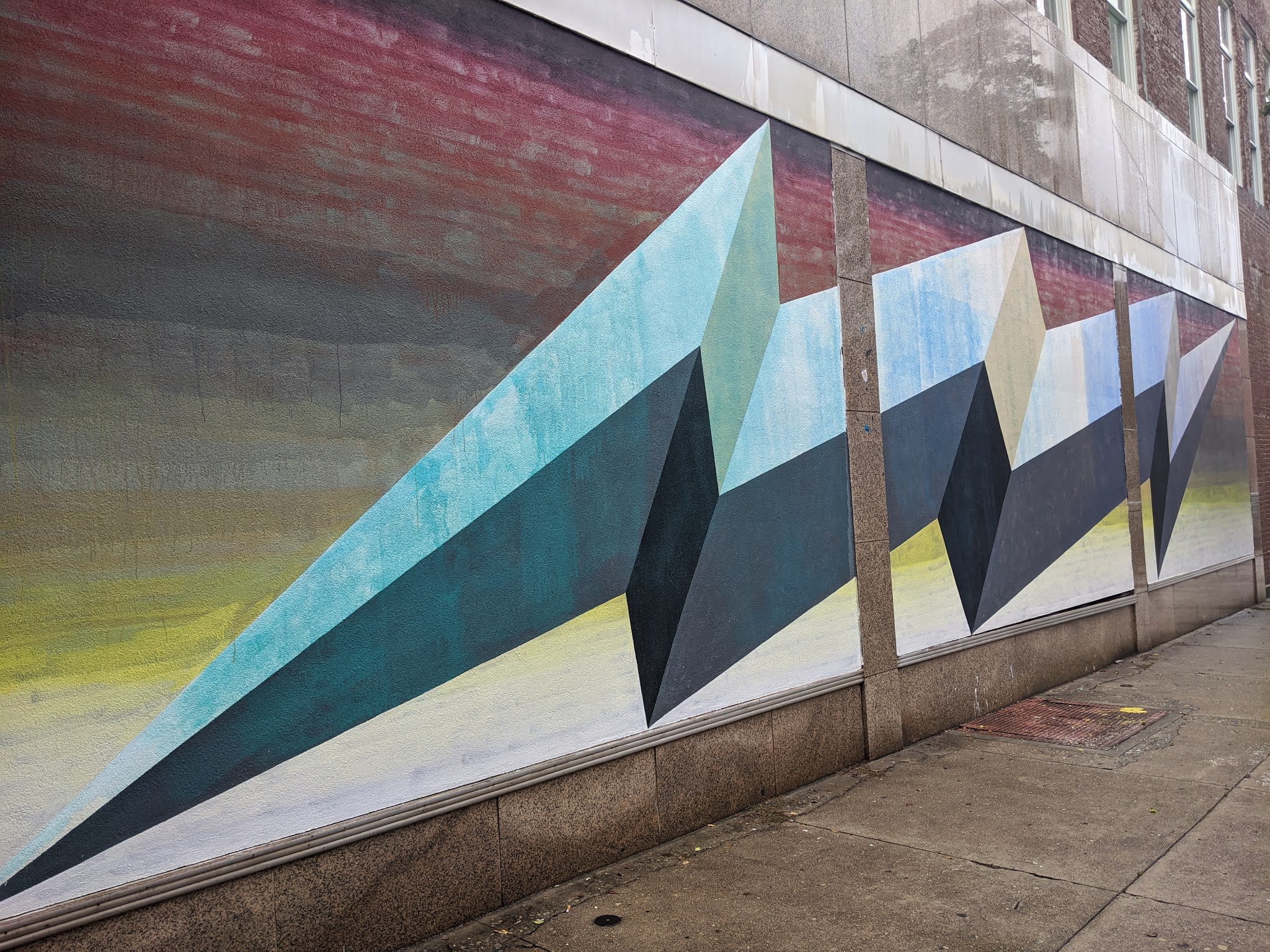
On the side of the Immaculate Consumption coffee shop was this gorgeous mural by Lauren Andreu. I wasn't sure if it portrayed an oncoming train or Aztec ruins!


I had to do some research to find the story behind this mural on Main Street. I read that it was a tribute to donut-loving Columbia musician Aaron Graves who died in 2019 at the age of 33, five years after being diagnosed with brain cancer. The mural was painted by Lauren Andreu and Claude Gilbert, both friends of Graves“It recognizes an important contributor to our cultural community and the impact he made on so many people.” The tribute mural featured images that represented parts of Graves’ character and his life: clouds in honor of Graves’ famous sky journal photos, an homage to Those Lavender Whales, and, of course, donuts.


I was so lucky that no one had parked in front of the Five Points Postcard in the neighborhood of the same name. Just like the neighborhood here in Denver, Columbia's Five Points was a local hotspot with plenty of bars and places to grab a bite to eat. The massive mural just down the street from multiple college campuses celebrated everything that Soda City was famous for.


This dynamic Crawfish Mural by McClellan Douglas Jr. was in the Rosewood section of Columbia and was designed to capture the vibrancy of the neighborhood because so many musicians and artists live there. Douglas had been commissioned to paint a mural involving airplanes but, after speaking with some small business owners in the area, he wanted “to do something fun and funky” and commemorate the crawfish festival. Unfortunately, as soon as the mural was complete, the crawfish festival was moved to the city's fairgrounds. 


The mural across the street in the Pelican's Snoballs parking lot captured the likeness of the Godfather of Soul James Brown by Columbia native Tripp Derrick Barnes.


Called The Barbershop, this mural also on Rosewood, was on the side of The World's Greatest Barbershop, which of course fit the theme of the artwork. If you look closely at the second photo, you'll spot Prince with his telltale purple guitar. I am not so musically inclined to recognize the other musicians in the painting.


The Chopped-Up Fox by Clay Wooten, on the side of the Cigar Box on Rosewood, was definitely more graphic than the others if you notice the bunny on the bottom chopping up the fox!


Interactive Artworks were the creators of the many murals that blanketed the front, sides, and back of Haven Home, a health services company. I was disappointed I couldn't find any information about the story of the murals as they deserved greater recognition.


Columbia was a capital city that delighted and enchanted me right from the get-go. I was hooked by its proximity to Congaree National Park, its extremely attractive capitol building, its intriguing architecture in the downtown core, its vibrant arts and historic districts, the extremely friendly people who went out of their way during the pandemic to welcome us to their city, and, of course, the public art and colorful murals in every area of the city. Though Steven and I had visited much of South Carolina half a dozen times or more over the years, we'd never toured its capital city before last summer. That had absolutely been our loss - we were so thankful to finally rectify that omission!

Next post: A stop in Camden, South Carolina, en route to Raleigh in North Carolina.

Posted on May 11th, 2021, just as the sun made a late appearance for the first time in days, glory be! Those of us here in the Denver area are heartily sick of all this constant rain and snow flurries and are looking forward to wearing warm-weather clothes instead of jackets and mitts again soon. Some locals even went so far as to take family Christmas photos outside today in the snow as they couldn't do it last December! I hope it is warm where you are - stay safe and be well.