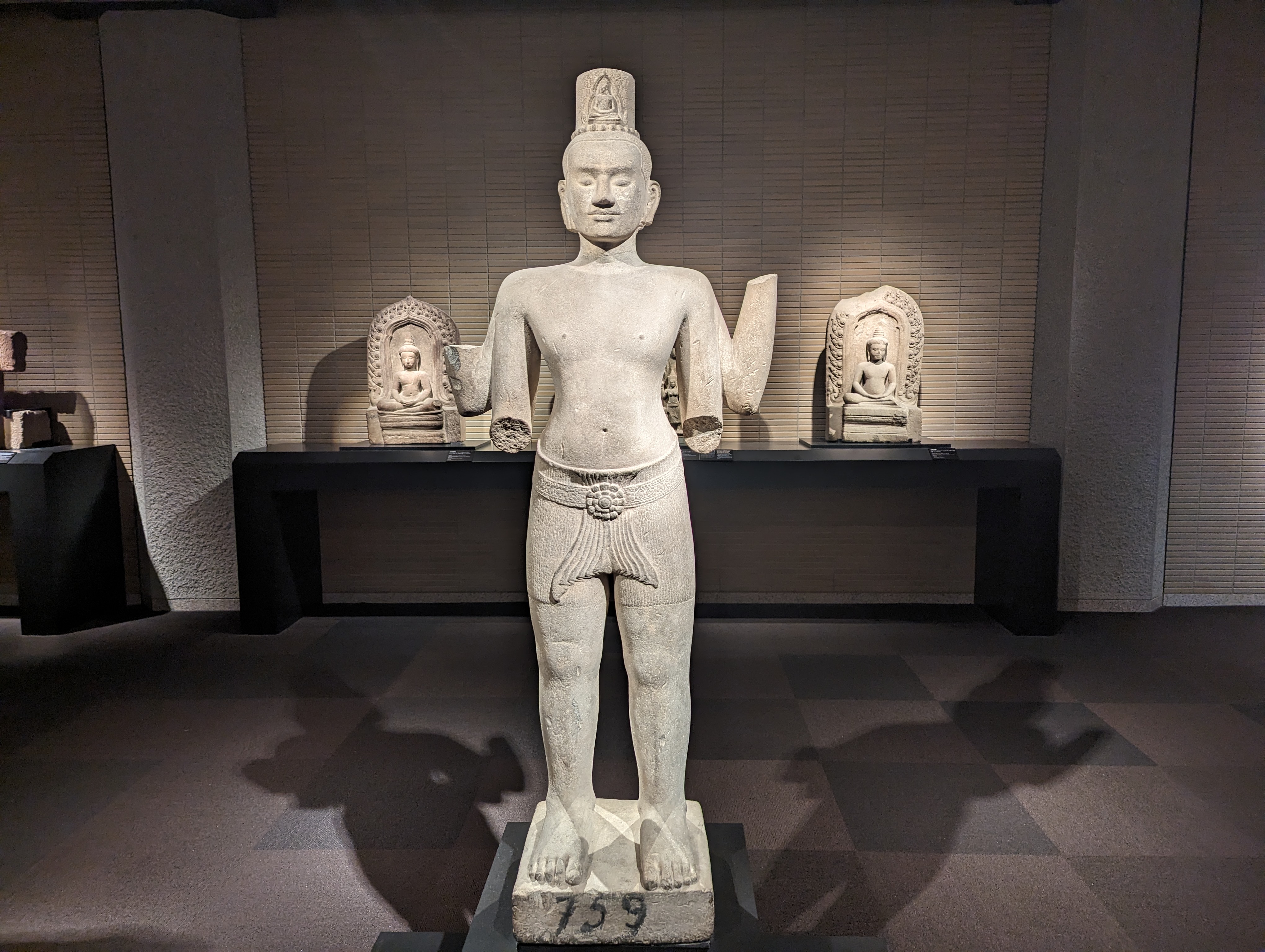
After somewhat of a letdown visiting the Tokyo National Museum's various galleries (in reality, separate buildings the size of museums in their own right), Steven and I continued walking through Ueno Park to the Toshogu Shinto Shrine. The gods must have let their love shine on the shrine as it survived all the major disasters that befell most of Tokyo's major historical structures: the fires, the revolt of 1868, the 1923 earthquake, and the bombings at the end of WW 2. As a result, it was one of the only buildings in the city from the early Edo Period that lasted from 1603-1868.
The torii gate separated the human world and sacred ground,

Two hundred ishidoro or stone lanterns lined the walkways from the stone entry arch to the shrine which was built in 1627 and dedicated to Ieyasu, the first Tokugawa shogun. A shogun was a powerful Japanese military leader and landowner who became strong enough to essentially rule Japan.

So many flags on the path to the shrine promoted the 45th Anniversary of the Ueno Tosyougu Peony Garden that we were happily waylaid for a bit! The many varieties of peonies were delightful just by themselves but seeing them shaded by the exquisite parasols was an added bonus.


The scent of the peonies was intoxicating!


Janina: Thought you'd be amused by this bathroom sign. All women's bathroom signs are in red here in Japan for some reason.


Just beyond the garden and hanging on a special holder by the shrine were emas, votive offerings made of wood as part of people's New Year's resolutions. After writing their prayers for success in tests or good health, the emas are hung in the belief that God will make their wishes come true.


Guarding the temple were a pair of Komainu, a mythical dog-like beast to repel evil.

We were saddened that our first visit to a temple or shrine in Japan had to wait as Toshogu was closed. However, watching as the faithful arrived at the entrance and then each following a specific shrine etiquette was enough to dispel any disappointment. A visit entailed the following by each person of faith: bowing slightly, tossing a coin into the box in front, ringing the bell to signal to the gods they had arrived, deeply bowing twice until reaching a 90-degree angle, then clapping their hands twice in rapid succession, paying their respects including thanking the gods, and finally bowing deeply once. Watching their expression of faith in front of the elaborate gold-carved door and the slanted roof was an honor.

Since the copper lanterns by the shrine were dedicated in 1651, they have become important cultural properties.

The Five-Storied Pagoda was dedicated by one of the top-ranking officers in the Tokugawa Shogunate to the Toshugu Shrine in 1631. After it burned down eight years later, it was rebuilt that same year. Since ancient times, the Japanese have held religious beliefs in both the traditional Japanese religion of Shinto as well as Buddhism which came from China. How sad is it that the comingling of religions in most parts of the world is so rare?
Though Toshogu Shrine is dedicated to Shinto followers, it is located on the premises of a Buddhist temple. That was why the pagoda, originally a Buddhist building, was built so near the shrine. The pagoda also survived the great earthquake of 1932 and the bombings in 1945. It was designated as an Important Cultural Property of Japan in 1911 because it was a distinguished structure from the early Edo Period.

Not only do Tokyo residents and visitors have the fabulous Ueno Park as their playground but also a large wetlands area a few steps away.


After the long flight from San Francisco the night before, Steven and I had walked the few minutes from our hotel over to the colorful Kaminarimon Gate, the entrance to Senso-ji Temple, the city's oldest and most decorated temple. Now it was time to explore the entire temple complex! An enormous chochin or lantern weighing 670kg hung from the center of Thunder Gate with ferocious protective deities on either side. Though the temple dates to 628, the gate has burned down innumerable times - this latest version only dates to 1970.

The underside of the lantern:

Whereas Toshugu had been so restrained and serene, the same could not be said for Senso-ji as there were always masses of people milling around! Once through the gate, the faithful and visitors were faced with the onslaught of navigating along lively Nakamise-dori, a pedestrian lane lined with 80 stalls selling souvenirs and snacks. It was a fun people-watching time but certainly the antithesis of a religious experience in my mind!


According to lore, two brothers fishing in the nearby Sumida River netted the biggest catch of their lives: a small golden statue of Kannon, the Buddhist goddess of mercy and happiness who can relieve suffering from all people. Senso-ji Temple was constructed in her honor and people come to pay respect to Kannon although it is never shown to the public.


At the end of Nakamise-dori was another gate, Hozomon, with two more fierce guardians. With the crowds and lighting, I wasn't able to take decent photos.

On the back of the gate were a pair of 2,500kg, 4.5m-tall straw sandals that had been created by 800 villagers to symbolize the Buddha's power and the belief that the giant footwear would carry off evil spirits.


Far ahead was the main hall called Hondo with its dramatic sloping roof. It was only constructed in 1958 after bombing raids destroyed the earlier one. In front was a large cauldron with smoking incense considered as food for the Buddha. Because the smoke is believed to confer health, people were wafting it over their bodies. I read that lighting your own incense stick off the burning sticks of others is not done since it means taking on their sins.


Again unlike at Toshugu Shrine where there were no crowds, a long line of people - worshippers and visitors - patiently waited to approach the temple's entrance.

The same rules apply to temple visitors as those visiting a shrine - bow slightly before entering, burn incense, again bow slightly, and toss a coin into the box in front of you. If there is a bell, it is rung two or three times. There was no bell at Senso-ji, just the constant din of people throwing coins in what looked like a huge trough with slats in it so the coins rolled and clanged until they reached the bottom. Please excuse my irreverence but I just couldn't get the sound of someone playing the slots at a Las Vegas casino out of my head.

The ceiling panels:

Sadly, I didn't 'feel' the religiosity or reverence at Senso-ji as was apparent at Toshogo. It seemed that people were there for a good time, to be chatting with friends, on their phones, to be seen above all else. I don't begrudge people that but there's a time and a place and the august temple was not it in my mind.


On the right side of the complex was Asakusa Jinja, a Shinto shrine honoring the brothers who found the Kannon statue.

I don't know why but only a few people were worshipping at the shrine even though it was merely a few feet away. Painted a deep shade of red, it dates to 1649 and is regarded as a rare example of early Edo architecture and an important cultural asset.

This was our first look at rickshaws in Tokyo but we saw more later in our visit. Again, I was struck by the blatant tourism aspect of its appearance in the temple complex.


Nitenmon Gate was built circa 1649 as the temple's east gate.

Kume Heinaido was a samurai in the Edo Period who killed many people with his sword. When he later regretted his actions, he built this shrine. Steven and I agreed he couldn't have rued his deeds so much as the shrine was mighty small!

We were almost running on fumes by then but still wanted a quick look at the other side of Senso ji's Main Hall at the Five-Story Pagoda. Founded in 942 and rebuilt in 1648 by Tokugawa Iemitsu, it was reconstructed in 1973 after it burned down during the war. Sri Lanka presented a bone relic of the Buddha to be placed in the pagoda's top story.


Walking back to the hotel, we saw several kimono rental shops and wondered if some of the kimono-clad women at Sensoji had been wearing rented kimonos.

Even though it was still only our first day in Tokyo, we'd already come across a lot of shops selling products made from matcha tea, a Japanese green tea made from finely powdered dried tea leaves. A Christmas green ice cream cone will have to wait a bit longer before it begins to look attractive!

It seemed that cartoon and cartoon-like characters were very popular in Japan.

When you click on this to make it bigger, you'll see another character on the right!


Somehow, we found the energy to go out for a stroll along the waterfront that night even though we'd walked miles and miles already on our first day in town. The Tokyo Skytree in the background:

A nighttime cruise on the Sumida River - I wonder if fishermen still hope for another lucky catch there!


We thought so much of Tokyo's architecture to be positively boring that these buildings were refreshing.

More on the very unusual sculpture in another post as we kept seeing it!

Wow, would it be hard to be a smoker in Tokyo as smoking is only allowed in enclosed glass cubicles with people looking at them like oddities at an old-time circus! I wonder how the Japanese government was able to have all smokers obey the no smoking on the street rules as trying to enforce that would lead to open rebellion in the US.

Steven suggested we walk back through Senso Ji again. Though the shops were all closed for the night, they still had vibrant images on their metal gates.


The Hondo looked beautiful all lit up ...


as did the Five-Story Pagoda!

At night, I was able to finally get a decent picture of one of the guardians at the gate.

The gates to the inner sanctum were closed so there was no scent of incense and, fortunately, no Ka-ching, Ka-ching sounds of coins being dropped into the coffers!

What a day it had been - starting at Ueno Park, then the Tokyo National Museum, followed by the Toshogu Shrine and the Peony exhibit, the circus atmosphere of Senso Ji in the late afternoon, an evening walk along the waterfront with a peaceful interlude back at Senso Ji to round out the day.

Posted early in the morning on May 5th, 2024, from the mountain town of Hakone southwest of Tokyo. As always, I hope you and your loved ones stay safe and well wherever you are.
Next post: A very rainy day exploring the Imperial Palace's East Garden and other sights in downtown Tokyo.