Wednesday, February 5, 2025

10/3/24: San Vito Lo Capo: Our Last Hurrah in Sicily!

Our hosts in Marsala provided a very filling breakfast that kept Steven and me going for many hours as we headed west to San Vito Lo Capo and then on to the Palermo airport.


Agricultural area by the town of Purgatorio and ...


... the stark landscape of northwestern Sicily near San Vito Lo Capo. Steven and I commented that we'd traveled so far to take in these majestic views while we, unfortunately, take for granted the equally spectacular mountain views back home of the Flatirons just up the road in Boulder. 


Photo from Colorado.com:


The small seaside town of San Vito Lo Capo is known for its beach, which is located in a sheltered bay overlooked by Mount Monaco. I've read that most Sicilians would say their island's best beach is this long curve of fine, white sand on the 3km-long beach. Nicknamed the Caribbean of Europe, a local said the sparkling blue-green water was "so clear you could see a mermaid’s pedicure!"


Photo from A Comprehensive Guide to Vising San Vito Lo Capo:
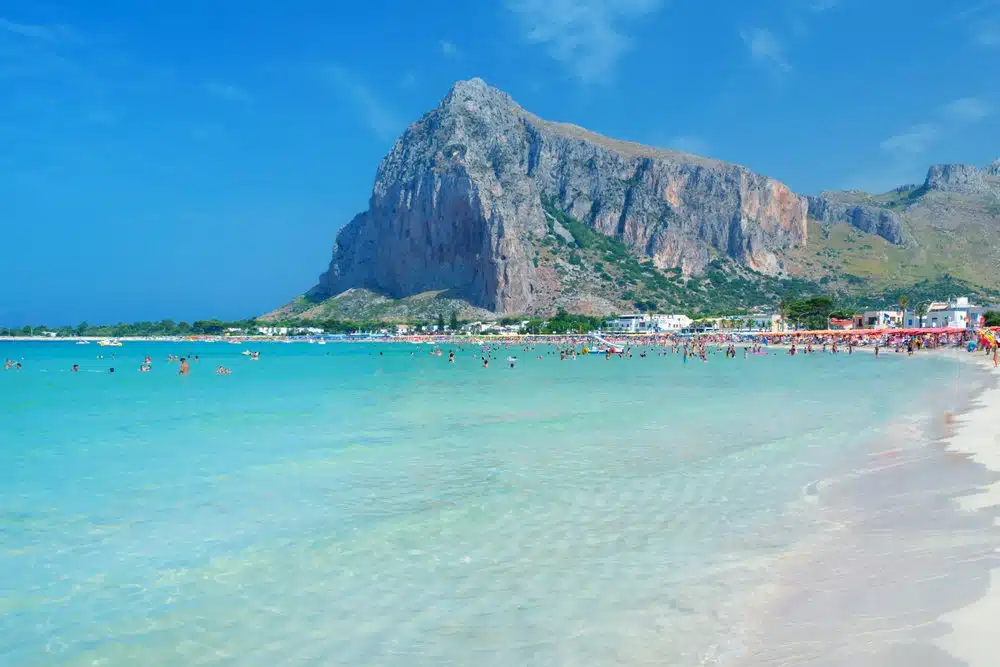

San Vito Lo Capo:


In a beautiful square in the heart of town was the 15th-century Santuario di San Vito, a fortress-like structure with Arab-Norman architecture. The Sanctuary is dedicated to the martyr Saint Vitus after the fall of Constantinople in 1453. The only church in the town, it was built around the original chapel dedicated to the saint with the aim of protecting it from pirate raids.


Wouldn't you want to stay here after seeing the sign?!


On the outskirts of town was a small Moorish-style 13th-century chapel dedicated to Santa Crescenza, San Vito’s nanny.


After spending two absolutely delightful weeks touring almost the length and breadth of Sicily, it was tough saying goodbye to the island that had captured our hearts. I shall long remember the narrow, winding lanes of the exciting hill towns (Steven not so much as he had to navigate them!), the magnificent golden-hued cathedrals from the Norman era, the sublime countryside views, the abundant and exquisite Greek and Roman archaeological sites, the many beaches that would have been perfect for sunbathing if we had more time, the profusion of towns and villages that lured us like a siren, the breathtaking natural sights like Etna, Scala di Turchi, and Marsala's salt pans to name a few, and, of course, the many delicious meals we devoured after a 'hard day' touring! 


A short flight later, but via Rome, Malta was calling our name for the next stop on our fall adventure. It was great that we were welcomed by fireworks - no, not really!


The Basilica of the Nativity of Mary was a Catholic parish church located in Senglea, the district where we stayed for several days in Valletta, Malta’s capital. 


After attempting to read the sign on the bench, we didn't think we'd be learning much of the Maltese language on our week's stopover! Here’s some useless trivia for you - it's the only Semitic language written in the Latin alphabet. According to Wikipedia, the language comes from a dialect of Arabic that was introduced to Malta in 869 or 870. Fortunately for us, English was Malta’s other official language. Italian was also an official language in Malta until 1934.


We could hardly wait to explore the city's Grand Harbor the following morning as it looked exquisite at night.


On the waterfront was the Senglea War Memorial.


Next post: Sicily Impressions.

Posted on February 5th, 2025, from sunny Miami, where we've come for a quick getaway before taking a short cruise to Cozumel, Mexico. Please take care of yourself and your loved ones.

Saturday, February 1, 2025

10/2/24: Marsala's Mesmerizing Salt Flats

Our last stop of the day, which started at the magnificent Scala di Turchi and continued to Mazara del Vallo for its Dancing Satyr and Kasbah, was Marsala, the town known worldwide for its richly colored fortified wine of the same name. Years ago, I loved ordering Veal Marsala when eating out at an Italian restaurant. I certainly never thought I'd actually visit the seaside town where it was made!

In 1773, a British wine merchant visiting Marsala discovered that the local wine was comparable to the port the British had long imported from Portugal. By the turn of the century, Marsala was exporting wine all over the British Empire.

Marsala also played an important role in the movement for Italian liberty known as the Risorgimento. In 1860, Giuseppe Garibaldi, the Italian national hero, landed in Marsala with his one thousand Redshirts to start the campaign to oust the Bourbons from northern Italy. 


Centuries before that, Marsala and the nearby island of Mozia were also the main bases for the Carthaginians in Sicily. From here, Carthage fought for power over the island against Greece and Rome and left behind the impressive archaeological sites we'd recently explored. 


Steven and I were inspired to stop in Marsala at the end of a long day after reading that the view of its salt pans and the windmills once used to power the area was declared "one of the most stunning scenes in Sicily." That seemed like lofty praise.


Lina: I imagine Dan and Alex would love the parasailing and windsurfing opportunities in Sicily's largest lagoon, the Stagnone di Marsala!


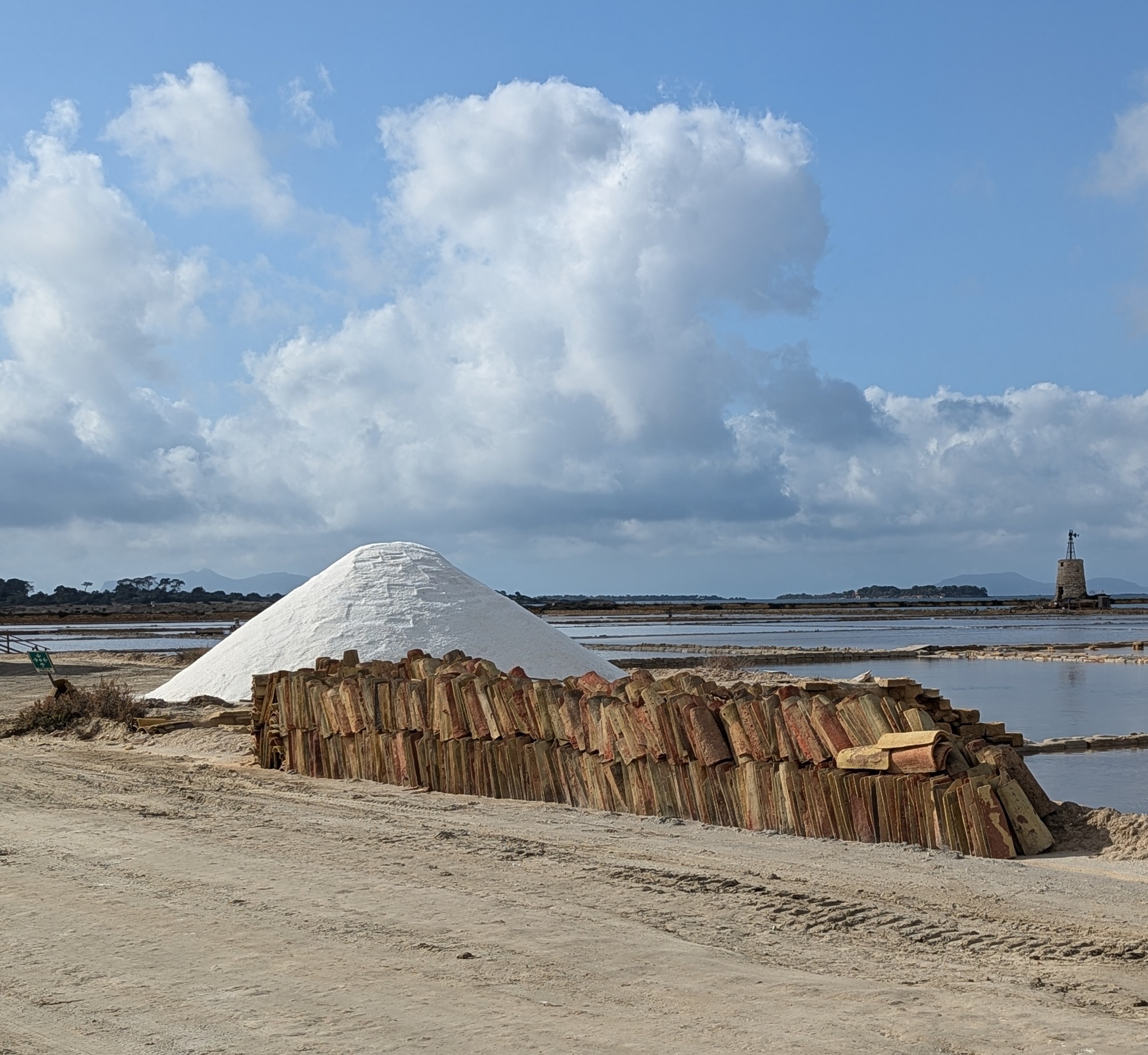
As we drove along the flat and winding coastal road north of Marsala, we soon came across the remarkable series of salt pans in the lagoon's shallows. The lagoon's shallow depth, ranging from just two to six feet, has made it perfect for salt production since Phoenician times. The scene's absolute flatness was only relieved by the conical heaps of salt and a smattering of disused windmills.


Most of the time, the scene was serenely peaceful and quiet except for occasional pockets of activity.


After witnessing so many stunning sights throughout Sicily, I don't know if the views of salt pans were the ultimate, but I know I could have stared at them for much longer than we had available. Seeing the clouds cast their shadows over the salt pans kept treating us to different captivating images.


The ancient windmill had been converted into a salt shop!


The pile of earthenware tiles was used to weigh down the salt so it wouldn't be blown away by wind gusts. 


As we hadn't made the required reservations to visit the 160-year-old Donnafugata Winery, a respected wine producer, we headed into the town of Marsala instead. Not surprisingly, the Parrochia di San Tommaso d'Canterbury dominated the Piazza della Repubblica. The Norman-era cathedral, also known as the Mother Church of Marsala, was constructed on the remains of a previous church destroyed during Arab raids. The stately Baroque structure was dedicated to St. Thomas Becket, Archbishop of Canterbury, an English Catholic martyr. 


The Chapel of the Holy Family's Baroque style was evident in its pyramid-style composition: the accentuated gestures of the figures, the scene's division into two levels - the upper level with the cherubim and angels and the lower one with the Holy Family - and the vivid colors based on yellow and red jewel tones.


Beginning in the 16th century, the Chapel of the Most Sacred Sacrament was managed by the fraternity of the Four Guilds: carpenters, cobblers, tailors, and silversmiths. The pillars were inlaid with their respective symbols: the axe, hammer, scissors, and anvil.


Neither of us remembered seeing Oriental carpets in any other Sicilian church before.


The exterior was graced with grand Baroque statues, but the interior was infinitely simpler. 


Adjacent to the Cathedral was the Palazzo VII Aprile 1860. The lovely, 15th-century arcaded palazzo, formerly known as the Palazzo Senatorio or Senatorial Palace, was now Marsala's town hall.


Our Marsala hosts recommended we catch a view of the sunset from the church across the street from their home. It was great advice after a long day exploring the southwest corner of Sicily. 


Next post: Arrivederci, Sicilia, and on to Malta at long last!

Posted on February 1st, 2025, from home in Colorado. Though I was complaining about the cold weather and snow a few days ago, Denver's 'winter' is back like we like it, with balmy temperatures and shorts weather for the locals at least! As I always ask, please take care of yourself and your loved ones.