Wednesday, October 23, 2024

9/17/24: Luxembourg City at Long Last!


After spending the last three nights in Vianden in north-central Luxembourg, Steven and I headed toward Luxembourg City, the country's capital where we were spending our last two-plus days. We stopped to see our last roadside chapel in Bastendorf en route.


Even though Steven and I were 'castled out' the day before after viewing several of the country's castles, we stopped at the little-known Walferdange Castle located in the small town of the same name in central Luxembourg. William I of the Netherlands, who was also Grand Duke of Luxembourg, built it as a stud farm for breeding horses between 1824 and 1828. 


It was converted into a royal residence by his son, William II, where he stayed when visiting Luxembourg. During the 20th century, the castle was used successively as a hospital, a teacher training college, an army barracks for the American and then the Luxembourg army, and a teaching institute, before it was acquired by the University of Luxembourg in 2003. 


Perhaps the donkey was a university mascot?


After returning the car at the airport and taking an Uber to our new apartment to drop off our bags, we jumped on a local bus located a minute's walk away to take us into the city. One of the huge benefits for anyone visiting Luxembourg is that public transportation is free for locals and tourists alike throughout the country! We'd never experienced that before. 

On the way into the city, we passed the country's only synagogue. 


In one of the central squares where all buses and trams stopped was the Hôtel des Postes de Luxembourg.


The last concert performed by Hungarian composer Frans Liszt took place at Casino Luxembourg. Because of the renovations, we couldn’t fully appreciate the former mansion dating to 1908 that currently hosts rotating contemporary art exhibitions.


The stately Adolphe Bridge over the Petrusse River: 


Towering over the triangular-shaped Place de la Constitution was the Monument of Remembrance more commonly known as Gëlle Fra, Luxembourgish for Golden Lady. If you read the previous posts, you may recall it was a war memorial honoring the thousands of Luxembourgers who volunteered for the Allies during both World Wars and the Korean War as well as the Luxembourgers who volunteered in the International Brigades during the Spanish Civil War. 


Atop the 21-meter-tall granite obelisk stood a gilded bronze statue representing Nike, the Greek goddess of victory holding out a laurel wreath as if placing it upon the head of the nation. When Luxembourg was occupied by the Nazis in WWII, the Germans dismantled the memorial in the fall of 1940. Fortunately, several portions of the memorial were rescued, and the monument was partially restored after the war. But the Gëlle Fra remained missing until January 1980 when she was found hidden beneath the main stand of the national football stadium! 


The lovely Cathédrale Notre-Dame de Luxembourg was built in the mid-1600s by the Jesuits and enlarged just before the Second World War.


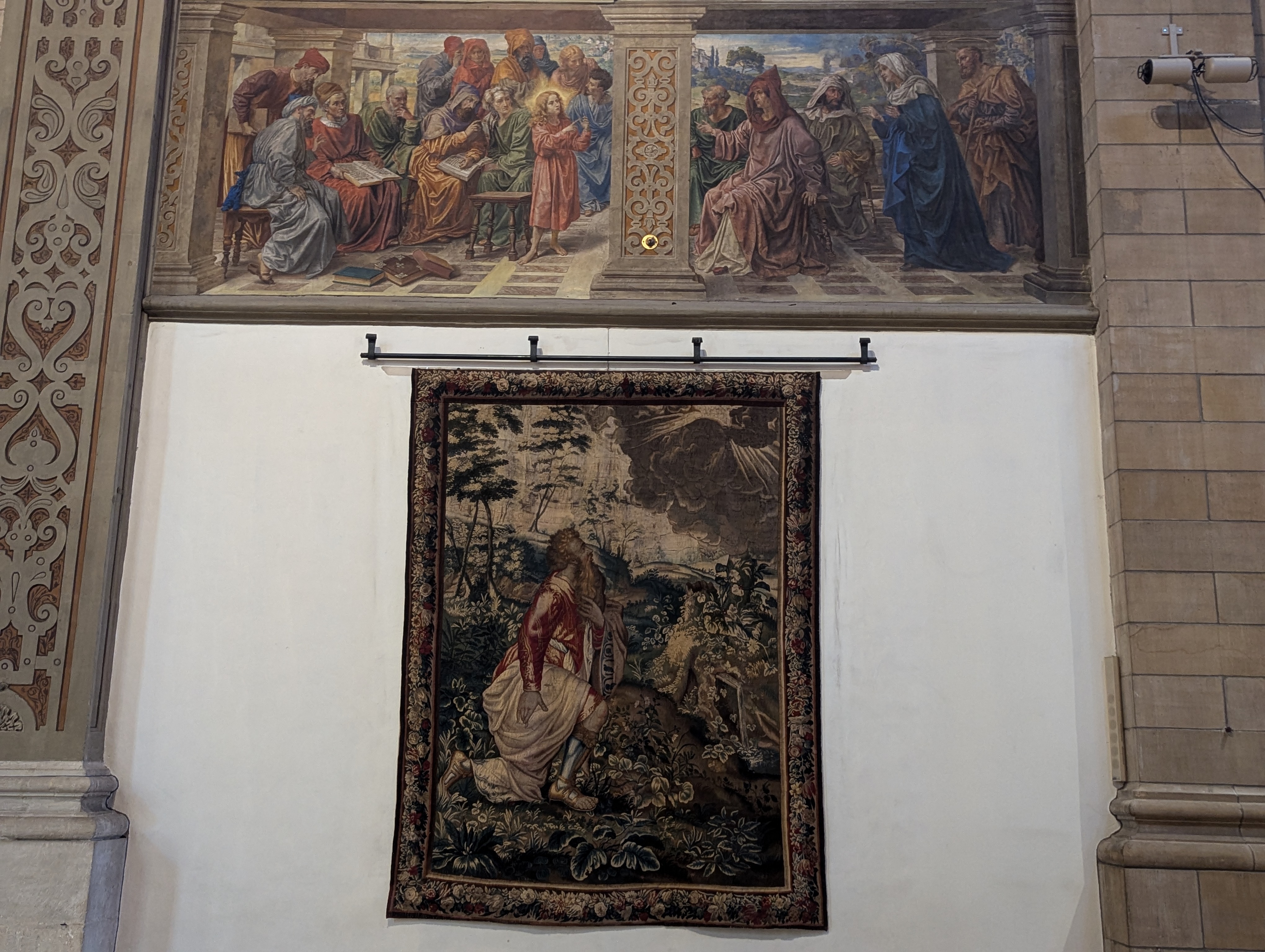
Tour books acclaim its distinctively elongated black spires but Steven and I were struck by its richly sculpted alabaster columns, tapestries, and stained glass. Let me know what strikes your fancy. 


Above the altar was a highly revered Madonna and Child idol.


The 1897 fresco depicted the Wedding at Cana. 


The crypt, dedicated to St. Peter, is mostly used for confessions, bishops' funeral services, and for the Grand Ducal family.


Two bronze lions bearing the Luxembourg coat-of-arms flank the entrance to Grand Ducal's family burial chapel. They were cast in 1934 and 1937.


From the adjacent Place Guillaume, we had a better view of the very pointy steeples!


The largest building in the square was the Hôtel de Ville or Luxembourg City (LC) Hall, a neoclassical-style building constructed in 1838 mostly from the stones of a Franciscan monastery that occupied the site. 


Taking center stage in the square was the statue of  William II, the King of the Netherlands and the Grand Duchy of Luxembourg, from 1792-1848.


A few minutes’ walk away and also in the center of the city was the Palais Grand Ducal, the official residence and where most of the duties as head of state of the Grand Duchy are performed though his principal residence is elsewhere.


We counted ourselves very lucky that we just happened to be there when the Changing of the Guard took place!


La Maison de Raville was a 16th-century residence where the Lords of Raville lived. We could only peer through the gate to catch this glimpse.


I loved the facade of this building on one of the many pedestrian streets in central Luxembourg. 


The city's famous Hammelsmarch statue portrayed marching bands parading down the street with a flock of sheep. 


For architectural buffs, LC is definitely worth a wander as there are buildings sporting Art Deco and Art Nouveau facades as well as enough other eras all within a few blocks to make your head spin!


We remarked that we hadn't remembered noticing so many independent bookstores before visiting LC. We smiled reading the English-language sign out front!


Nearby was the Saltimbanques or Acrobats statue.


Why don't more cities honor their history and people of note with more than just a street name as LC does?


On our way back to the apartment we'd rented, we passed a pretty park and appreciated the fact you could walk wherever you wanted, unlike the parks we'd recently visited in Japan.


In the past, because some readers have expressed interest in where we stay when we travel, I'll try and include some photos from time to time. Our abode in LC was a winner!


Next post: Walking along the Corniche, described as Europe's most beautiful balcony!

Posted on October 23rd, 2024 on our last night in Tozeur, Tunisia where we've seen more than a few mosques, more than a few oases, and enough desert over the last few days to last us both a good long while! Please take extra special care of yourself and your loved ones.

Sunday, October 20, 2024

9/16/24: Luxembourg's Castles & the American St. Nick!

As Steven and I drove north from Vianden toward the castle town of Clervaux, the scenic Our River divided Luxembourg and Germany just as the Moselle River in the southern part of the country had a few days previously.


The community of Roderhausen in Germany was just a stone's throw away from Vianden!


Clervaux's whitewashed castle was an exact replica of the original that was built in 1129 but was demolished during WW2. Unfortunately, I hadn't done my homework because we arrived hoping to see the castle's three museums but everything was closed that day. We had really hoped to view the UNESCO World Heritage site containing Edward Steichen's Family of Man photography exhibit that had been gifted to Clervaux in 1964. The "essential oneness of mankind" includes over 500 black-and-white photos by 273 photographers taken during the mid-20th century.


We didn't know the story behind these photos in the castle garden but enjoyed them in place of the Family of Man.


A glimpse of Clervaux from the castle:


Steven's driving skills were put to the test as he navigated up the tiniest and curviest of roads to the neo-Romaesque Clervaux Abbey, a Benedictine Abbey that dates to 1908 that was also closed! As you can see, we arrived at the worst possible time to take pictures. 


Photos from the open crypt:


There was a small altar for Mass in the crypt.


A sign said that when the abbey's religious community was expelled by the Gestapo between 1941 and January 1945, they found refuge in Belgium. During the war years, the Nazis transformed the abbey buildings into a school for Hitler youth.


From northern Luxembourg, we headed south through rolling hills and farmland typical of the central part of the country en route to Wiltz, the capital of the Ardennes region.


Roadside chapels like this one in Walterdange are commonly found at intersections in small communities.


A two-story mural in Wiltz: 


Just outside the town was the National Strike Monument. In the previous post, I wrote about how the introduction of compulsory military service into the German army in August 1942 resulted in a general strike against the German occupiers. What I hadn’t known was that the strike broke out in Wiltz before quickly spreading throughout the country. The Nazis responded with brutal violence, executing 21 Luxembourgers. 


The monument in the shape of a lighthouse commemorating the strike victims was built of Wiltz slate. The red sandstone relief symbolizes the courageous resistance of the Luxembourgers against the overpowering Third Reich. 

The monument is seen as a memorial to the free world to always stand up against violence, oppression, and disregard for human rights. The courageous victims are commemorated in a memorial ceremony each August 31st.


The striking Hôtel de Ville or City Hall was built in 1880.


In the square next to the town hall was the Justice Cross.


Notre Dame Parish Church:


The area behind the city hall was renamed Eisenhower Square because General Eisenhower, the commander of the Allied forces during the war, stayed in Wiltz in November 1944 while meeting with fellow generals. In honor of his stay and with thanks to the US Army who liberated Wiltz, the city built the General Eisenhower Memorial from Ardennes stones.


Nearby, a sign told the story of the American St. Nick. While soldiers of the 28th Infantry Division were recovering in November 1944 from injuries suffered in recent battles, one of them, Harry Stutz, chatted with the locals. He learned that many local children had never had a St. Nicholas Day celebration because there had been no candy during the German occupation.


After receiving permission, Private First Class Stutz organized a St. Nick party for the children with candies and chocolate donated by the soldiers, and the unit bakery making donuts and other sweets for the children. After persuading his friend Richard Brookins to play St. Nicholas, he appeared in a jeep accompanied by two young Wiltz girls wearing angel costumes. The children sang songs and recited poems while candy was handed out to people of all ages by the soldiers. It was the first time many of the children had tasted chocolate.


Brookins often returned to Wiltz and helped maintain the spirit of the American St. Nick. Here he was in 1994 with his original angels!


The memorial honored the US 28th Infantry Division for liberating Wiltz on September 10th, 1944, and "gallantly defending our soil during the Battle of the Bulge." 


Wiltz Castle: After the actual, first castle of Wiltz was built in Niederwiltz to protect the town from its enemies, its location had been so badly chosen that it was constantly taken! In the 13th century, the lords of Wiltz built a new castle on a higher promontory. In 1631, construction began on this Renaissance-style castle and it was completed around 1720. The castle now houses the National Brewing Art Museum and the Museum of the Battle of the Bulge, as well as a tourist information office.


We weren't interested in beer art and had our fill of war museums after touring the excellent National Military Museum in Diekirch the previous day so just wandered around the small grounds. 


Every June and July, the castle’s staircase serves as the stage for the Wiltz Festival. Concerts, theater events, and other artistic performances are presented live on stage in the magnificent amphitheater in front of the backdrop of the castle.


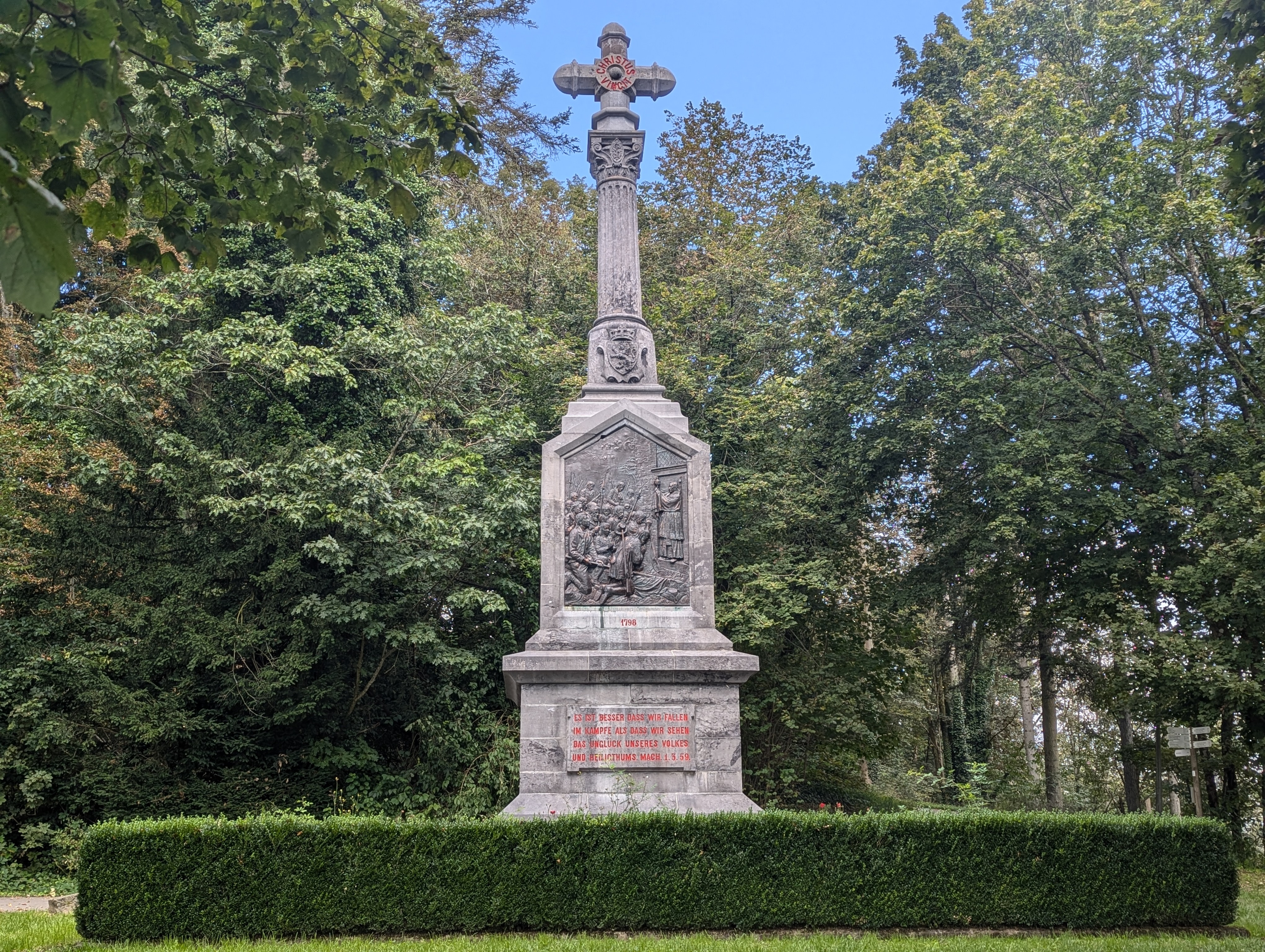
At another roadside chapel, there was a different monument: a bomb that was dropped by a US aircraft on Christmas Day 1944 but luckily found in the woods near the chapel. The sign said it was in memory of the locals and Allied troops who lived through the horrors of the Battle of the Bulge. 


Heading southwest, we came across another one of Luxembourg's pretty-as-a-postcard villages, Esch-sur-Sûre on the Sûre River. 


Overlooking the town were the ruins of a 13th-17th century castle tower. 


Click on the picture to enlarge it and you'll see why Steven and I nicknamed this the dipping dot house after the candies of the same name!


Janina: I'll agree with you that it was pretty bizarre that we saw nary a soul or a shop on our stroll through the village. The village was beautiful but it looked like a movie set, it was so eerily quiet.


In 1999, Luxembourgish sculptor Bertrand Ney invited five sculptors to help create a sculpture path near the Haute-Sûre municipality of Lultzhausen. After reading that it was part of the European Sculptures Route of Peace, walking the path seemed very appealing as we love both walking and sculptures.

Stupid us as we naively thought we were embarking on a sculpture path, not a long hike through very hilly terrain with sculptures set far apart! The fault was ours in terms of our expectations and what physically we felt we could do comfortably. Having a brochure written in German didn't help much either!


Georg Ahrens from Germany created the Stone Tower overlooking the river.


The sculpture by Belgian Jaak Hillen:


We gave up after the distances were too far apart between works that didn't really strike our fancy. It just wasn't worth schlepping to view Jacob's Ladder in the distance by Ney, the project's local founder.


We discovered this roadside chapel in Heiderscheid on our way to Bourscheid.


Occupying the site of a former Roman watchtower, parts of the impressive Château de Bourscheid were constructed around 1000 AD. The castle’s name derives from its first lord, Bertram of Bourscheid, who was mentioned in 1095 for the first time. The inner walls and belfry date from then. Like Luxembourg’s other castles, Bourscheid also stands atop a cliff – its 150-meter height overlooking the Sauer River made it impregnable by medieval weapons. 


Because of its virtual inaccessibility, the castle quickly became of strategic importance and underwent multiple enlargements and restorations which explain its differing architectural styles. For example, 1350 saw the addition of the outer circular walls, the courtyard around 1447, and the southside towers and prison in 1498.


By the early 19th century, the castle was deteriorating. After it was purchased by the Luxembourg government in 1972, major archeological excavations and restorations were undertaken.


We climbed the stairs to the Keep, a type of fortified watchtower, for some magnificent views of the area.


Far, far below was the Sauer River.


The view of the Lower Courtyard from the Upper Courtyard:


This picture is also worth clicking on to show the mosaic floor. 


The castle's Stolzemburger House had been converted into a bare-bones museum.


Models portrayed the development of the castle through the centuries.


I think I've mentioned in prior posts on Luxembourg that there are three official languages in the country: Luxembourgish, French, and German with the latter two reflecting its immediate neighbors almost on their doorstep. Since we'd been traveling throughout the country the last few days, we noticed that the town signs also reflected the dominant language spoken in that specific area of the country we were driving through. 


Though it was our third night returning to our hotel in Vianden, the same view of the Château de Vianden still left us breathless. It received an almost total restoration during the 20th century after the original, built from the 11th to 14th centuries, had fallen into complete ruin. 


Steven and I were ' castled out ' after touring what surely had to be all of Luxembourg's other castles in just a few days, but we wanted to at least see Vianden's up close before leaving in the morning. 


Here's a much better shot of Vianden's 'adopted son' Victor Hugo than one I'd been able to take before with the sun on his head.


Most of you know that Steven and I are not 'foodies' but Rodin's sculpture of the writer must have inspired us to treat ourselves to dinner at his namesake Hôtel-Restaurant Victor Hugo that night!


Hotel Heintz, our home away from home in Vianden:


Next post: After exploring what felt like every inch of the country, it was on to Luxembourg City, the capital at last!

Posted on October 20th, 2024 from Matmata, Tunisia, home to troglodyte houses and famous for its Star Wars-themed attractions. This is the first accommodation in ten days in the country where the internet has been anything but abysmal. I'll post again as soon as the internet and time not spent touring allow! Please take extra special care of yourself and your loved ones as time is so precious.