Sunday, January 26, 2025

10/2/24: Selinunte Greek Ruins & Cava di Cusa


Sadly, the heaps of trash continued to be a familiar sight as Steven and I drove from Sciacca west along the coast toward Selinunte, a town known for its numerous ruined Greek temples. The town is named after a local variety of wild celery that grows in profusion each spring.


Selinunte, one of ancient Greece's most important colonies, was recently discovered to have been home to the largest industrial area in any European city. Established in the 7th century BC, the city became prosperous through trade and the manufacture of ceramics. In 400 BC, a Carthaginian army razed Selinunte, which had been sent by its rival, Segusta, to be destroyed. The temples were demolished, and 16,000 of its inhabitants were massacred. 


The rest of the complex was 2.5 km away.


A picture to add to my collection of unusual bathroom photos from around the world!


The modern discovery of the remains of Temple E-Heraion is traced to 1823 when two young British archaeologists found the temple's famous sculpted metopes, the rectangular architectural elements that adorned the outside of Doric temples. The only part of the sanctuary still standing was a portion of one wall. It remained that way until the 1950s when the temple was almost entirely rebuilt.


The diagram imagined what the temple would have looked like in its heyday.


Unlike at the temples at nearby Agrigento, visitors were surprisingly welcome to stroll among the temple ruins. 


Seeing the assortment of capitals and blocks around the temple made me wonder if this was a puzzle-maker's dream or nightmare! Recent discoveries by archaeologists have included pots with the remains of food inside, proof that some people were in the middle of eating when the attacking Carthaginians arrived. 


Burn marks still scarred Greek columns, and much of the site remained in rubble in the same collapsed position.


A pillar from Temple F, dating from the late Archaic age, may have been dedicated to Athena, Hercules, or Dionysius. Temple E is in the background.


Olive groves surrounded the temples and ruins.


The pile of rocks, formerly known as Temple G-Olympieion, was one of the largest in the Greek world. It was built to compete with the large Ionic temples in Asia Minor. Archaeologists have determined, from an inscription dating to the mid-5th century, that it was dedicated to the Olympian deities and other major deities of the city: Zeus, Apollo, etc. I remain stupefied that archaeologists could determine that one of the ancient world's major temples existed from what we saw in front of us.


It's too bad there weren't any young children around, as they would have loved clambering among the piles of rocks!


In the middle of the ruins and temples was a small museum.


Inside was a portion of the recreated 6th-century BC Temple Y with the menotes, the sculptures at the top. Archaeologists determined that many of the temple's elements were readapted for reuse. Although the building's original location remains a mystery, enough of it was preserved to permit its general reconstruction.


The floral decorations dated from the Corinthian period, 590-570 BC.


The terracotta Statue of a standing female figure was from the second quarter of the 5th century BC. 


Remarkably, the roof fragment from Temple E, which dates to the middle of the 6th century, still had faint coloring. I wondered how archaeologists knew the fragment was attributed specifically to Temple E and not any other temple.


The image shows what a more complete version would have looked like.


Fragment of an Attic red-figure krater, circa 500 BC:


The elegant, Enthroned temple goddess dated to 500-480 BC.


No less than Jean-Paul Sartre opined that the temples of Selninute had more weight than many words.  


The map shows the proximity of southern Sicily to Carthage in present-day Tunisia, which we'd be exploring after Malta. 


Steven and I chose to forego touring the other two sections of the archaeological park as we were "templed out" at that point in the trip and we knew we had more to view later on!


We drove next to Casa di Cusa, a limestone quarry 11 km northwest of Selinunte. Ancient Greek builders prized the limestone because it was a stronger and more resistant construction material than the fossilized shells abundant in local stone. The quarry's current name refers to Baron Cusa, the area's former owner. However, in the 18th century, it was known by its Arab name, Ramuxara. The quarry, used since the first half of the 6th century BC, was abandoned when mining began and also with the advancement of Hannibal's army in 409 BC.   


Historical engravings at the end of the 18th century hypothesized the entire stone removal and transportation process. First, the rocks' surfaces were cleaned and sanded. Then, a circular channel was dug around the rock to make the stonemason's work easier. The rocks were then detached using metal wedges. They were transported to the building site on sleighs with wooden wheels pulled by draft animals. Finally, the rocks were carried along a nine-to-ten-meter-wide rocky road that is no longer visible due to land transformation. 


As we wandered through the gorge, we came across broken discs and rocks that had been cut and then abandoned.


Viewing and being able to touch the marks made by tools that were centuries old with no one else around was an extraordinary experience.


Next post: Marzala del Vallo's Dancing Satyr Museum & Kasbah later in the day.

Posted on January 26th, 2025, from the Chicago suburb of La Grange, where we came for the weekend to help celebrate our youngest granddaughter's second birthday. If you're in chilly parts of the world, stay warm, and please take care of yourself and your loved ones. 

Tuesday, January 21, 2025

10/1/24: WOW - the Scala de Turchi & Sciacca Stroll!

Our last sight in Agrigento, home of the stunning Valley of the Temples, was a monument honoring Don Bosco. The Italian Catholic priest dedicated his life to the betterment and education of street children during the Industrial Age in late 19th-century Sicily.


It was sad to see scads of trash littering the roads outside of Agrigento as we drove west.


The soft golden sand and the blue water at Lida Majata, or Majata Beach, looked divine, but we were there to view the Scala de Turhci, or Turkish Staircase, located along the stretch of sea between Realmonte and Porto. 


It wasn’t a real staircase, however, but a spectacular stretch of coastline that has become a huge draw for tourists thanks to its special features. The Scala’s dazzling white cliffs, due to the minerals present in the rocks, are made of marl, an unconsolidated sedimentary rock consisting of clay and lime. The staircase was wavy and irregular, with soft, rounded lines.


The name Scala dei Turchi comes from the Saracen pirates, who were mistakenly called Turks instead of Arabs by the local people. In the 1500s, they found shelter in the bay and landed on this rocky formation to plunder coastal villages, such as the modern-day Realmonte. The natural staircase, hence the name Scala, sloped into the blue water, making it easy for the marauders to land from the sea and conduct raids. The area was sheltered from the winds and probably also poorly controlled.


One of the tour books described the magnificent sight this way: "After the active volcanoes of Mount Etna and Stromboli, the tilted white 'staircase' of the Scala dei Turchi cliff is the most stunning geological site in Sicily." I couldn't agree more!


As we drove further west, we never tired of seeing olive orchards that were a common sight throughout Sicily. 


We enjoyed lovely views of Siciliana, but we didn't have the time to explore the town.


I've written before about our frustration with whoever devised the speed limits on the island's roads. It seemed insane that drivers were limited to just 50 km/h on this wide-open highway, which had no lights or side roads that necessitated slowdowns.


Mountaintop ruins in Montallegro:


One of the joys of driving through Sicily for almost two weeks was the gorgeous, serene views.


After spending almost two weeks in some of the island's most popular and glamorous cities, we enjoyed a nice getaway to explore the fishing port of Sciacca. Seasoned Sicilian travelers call this their favorite destination because it is an unheralded spot in tourist literature. While there were no must-sees or major sights, we still looked forward to strolling along the grand terrace high above the port, which is the last of Sicily's three great ceramics centers. 


Just like we expected in a town famous for its ceramic wares, Sciacca had ceramics shops on every street, each we knew would be filled to the rafters with colorful plates, pinecones, jugs, and birds like the other ceramics centers we'd already toured. However, Xacca Maoliche, run by a young craftsman, Giovanni Muscamera, had some unusual and refreshing designs.


We noticed an old church on the main drag, just two minutes from where we stayed at the Vittorio Emanuele Boutique Hotel, which had been converted into Pizzeria Arco Antico.


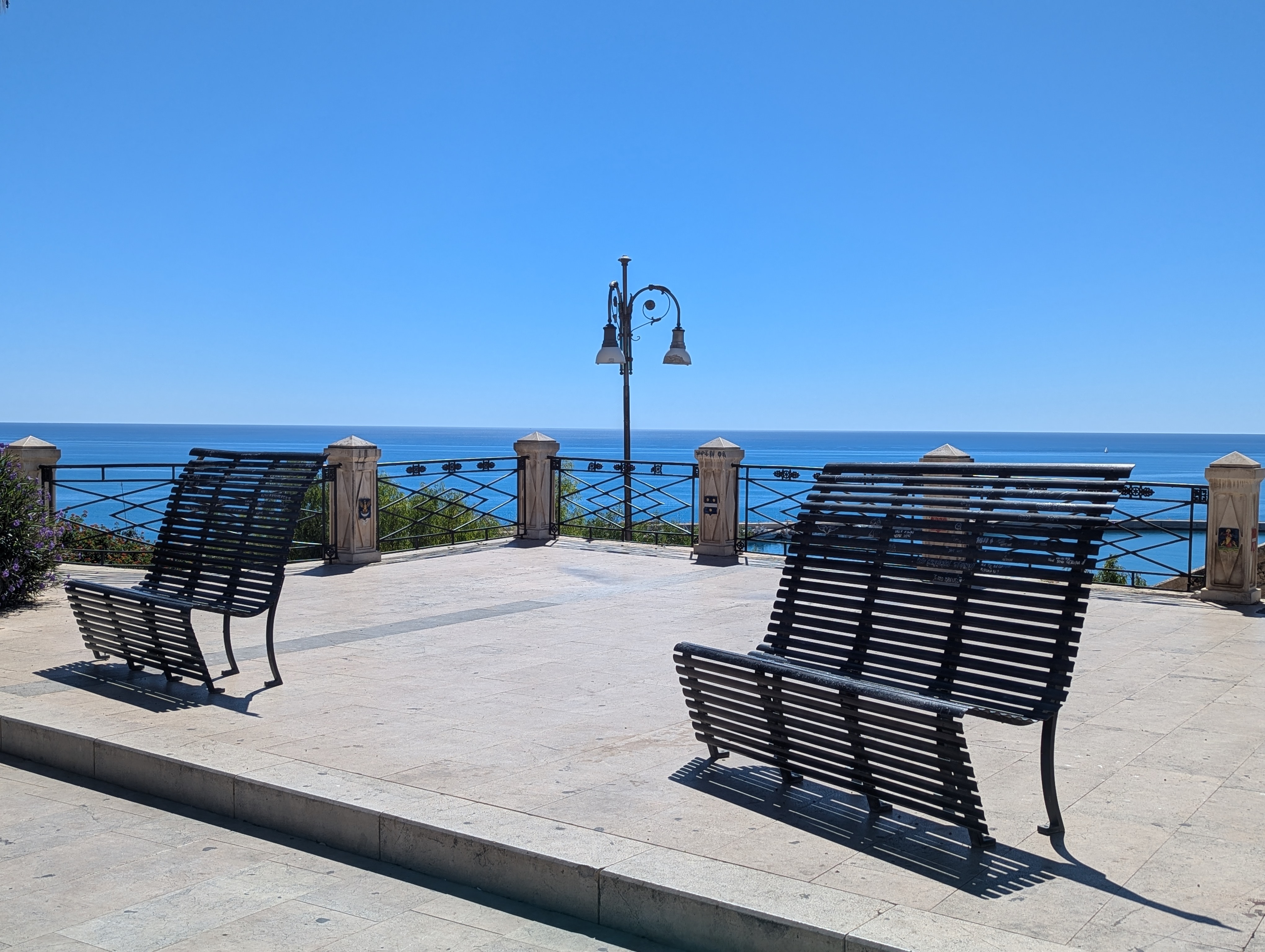
Just beyond the adorable flower boxes in the narrow lane was the terrace or Piazza Scandalito.


I suspected that the terrace's pillars were emblazoned with the town's notable families' crests.


At one end of the piazza was the 18th-century Chiesa di San Domenico.


Though the piazza looked awfully dead in the mid-afternoon, I suspected it and the carousel would be far livelier that night. And, indeed, both were!


It was siesta time in the historic center of Sciacca at the Duomo and the large Piaaza Duomu in front, so we intended to walk by both later.


The Palazzo Savasta was on the left, and the Palazzo Cassar was in the middle of the piazza. On the right was the 19th-century Casa Museo Francesco Scaglione, itself also a former palace that had been built on the spot where a 14th-century church once stood. Knight Francesco Scaglione, a man of great culture and curiosity, erected his palace and surrounded himself with works of art from the Mediterranean world. I read that “The house is a great example of the nineteenth-century lifestyle of a bourgeois family in Sciacca with a passion for art and collecting.”


More views as we strolled through Sciacca's charming lanes:


As Sciacca was also well known for its coral, there were also lots of jewelry stores in town.


The view of the main drag from our balcony during our siesta!


I'd bet this was the fanciest public ashtray I've ever seen.


On the walk back to the Duomo, we passed many more ceramics stores  - there were so many, they just overwhelmed me.


Back at the Duomo:


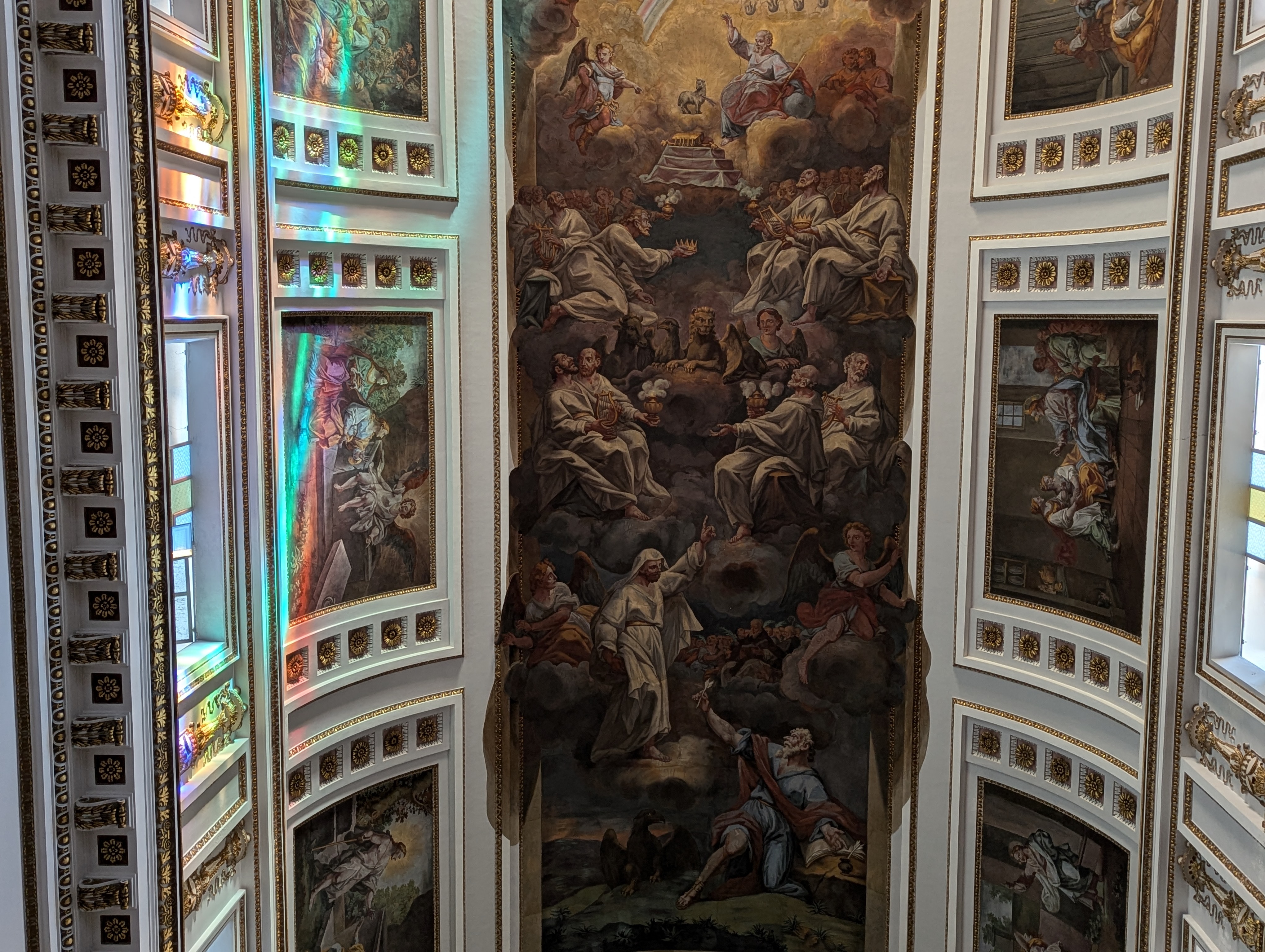
I don't remember ever spotting a seeing eye in a Catholic church before.


And then, yet more ceramics and artisans at work!


Not far from the historic center was the luminous green dome of the Church of Carmine and ...


... the 17th-century Porta San Salvatore. The gate, made of conch stone, featured an elegant sculpture of an eagle with its wings spread, representing the reigning Bourbon dynasty. 


Nearby was the similarly shaped and adorned Porta Palermo.


The Palazzo Steripinto was a heavily decorated and fortified palace with diamond-shaped stones that covered its entire facade. It was built at the beginning of the 15th century by Sciacca's Nocento family. Interestingly, there's also a diamond-shaped building in the Kremlin in Moscow built by Italian architects, but I don't remember seeing it when we visited long ago.


We lucked out with our restaurant choice, both in terms of its location in a lovely square across from the palazzo and the mouth-watering pizza. John: You may remember I called you from there to ask about Paul that night.


And yes, the terrace, carousel, and the renovated church cum restaurant were all full of people enjoying the evening air! I thought it interesting that while Sciacca was described as a working town, it still had several palatial homes, an impressive cathedral, a vibrant ceramics center, and some striking architecture that appealed.

Next post: The Greek ruins of Selinute.

Posted on January 21st, 2025, from a very chilly Denver. During the final hours of this week's Arctic blast, one town in Colorado reached 44 degrees below zero. Our upcoming quick escape to Miami and some ruins in Mexico can't come soon enough! Take care of yourself and your loved ones, and be sure to stay warm.